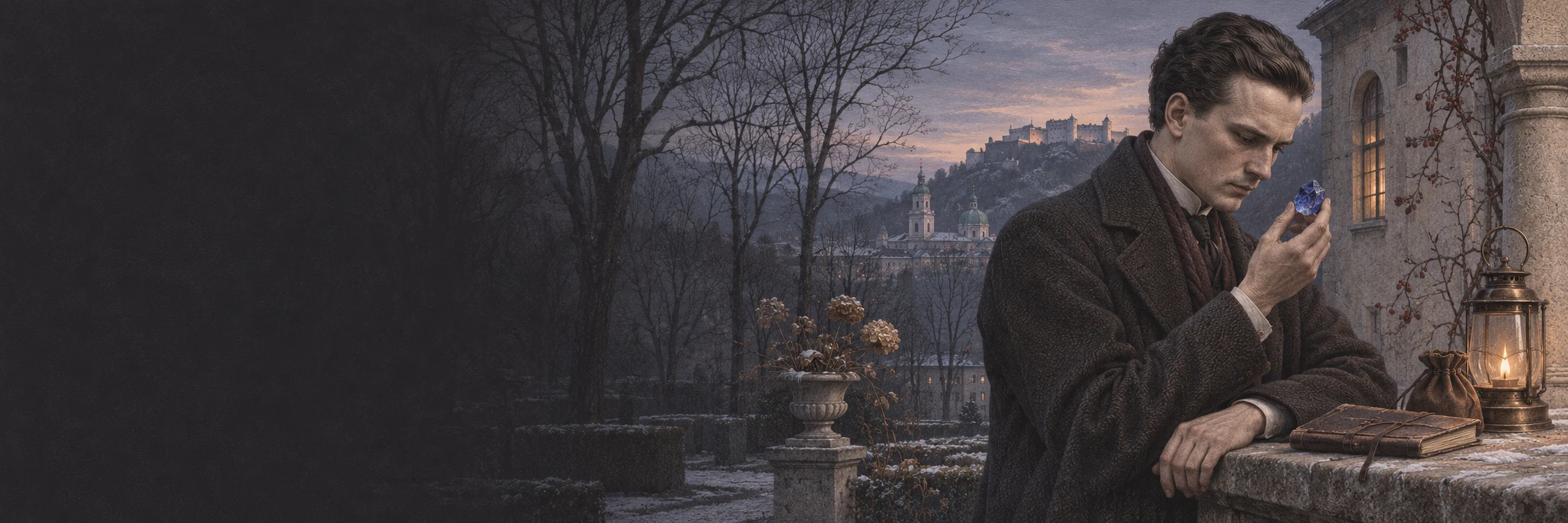
Georg Trakl (1887–1914) was an Austrian poet from Salzburg. In *Ruh und Schweigen* a man comes close enough to the stars to rest his cheek against them. Trakl needs just three German words to say where this happens: “In blauem Kristall.”
Bringing the sky within reach
It is easy to miss how carefully Trakl prepares this moment. First shepherds bury the sun in a bare wood. Then a fisherman pulls the moon out of a freezing pond in a net of hair. In the second image we can still recognise a familiar sight: the moon reflected in water, its reflection disturbed as someone lifts a net. Trakl leaves out the word “like.” For the length of the poem the fisherman really does bring in the moon. After these two pieces of work the distance between earth and sky has changed. A man can now rest his cheek against the stars.
In blue crystal
The pale man dwells, his cheek leaning against his stars;
Or he bows his head in purple sleep.
– Georg Trakl, Sebastian im Traum, p. 41.[1]
What it means to dwell in crystal
Much turns on the preposition “in.” The man neither holds the crystal nor looks through it. He lives there. Blue suddenly has an inside, with room enough for a man and his stars. Yet what he does is an ordinary gesture. One rests one’s cheek on a pillow, or against someone with whom one feels safe. A crystal can still be imagined as hard and cool. That makes the tenderness of the gesture seem all the more exposed.
The “or” in the last line offers another picture of almost the same posture. A moment ago the cheek rested against stars; now the head bows in sleep. Purple replaces blue. The poem leaves us to wonder which scene might explain the other. Stone returns later, when night falls again about the man’s brow. Read in the light of that later line, the blue crystal looks a little different: for a moment it was possible to make a home so close to the stars. It was not a place the man could stay.

 Phone: +43 677 628 66 628 |


 Search
 Epistolae · o. J. · p. 353













 Cart