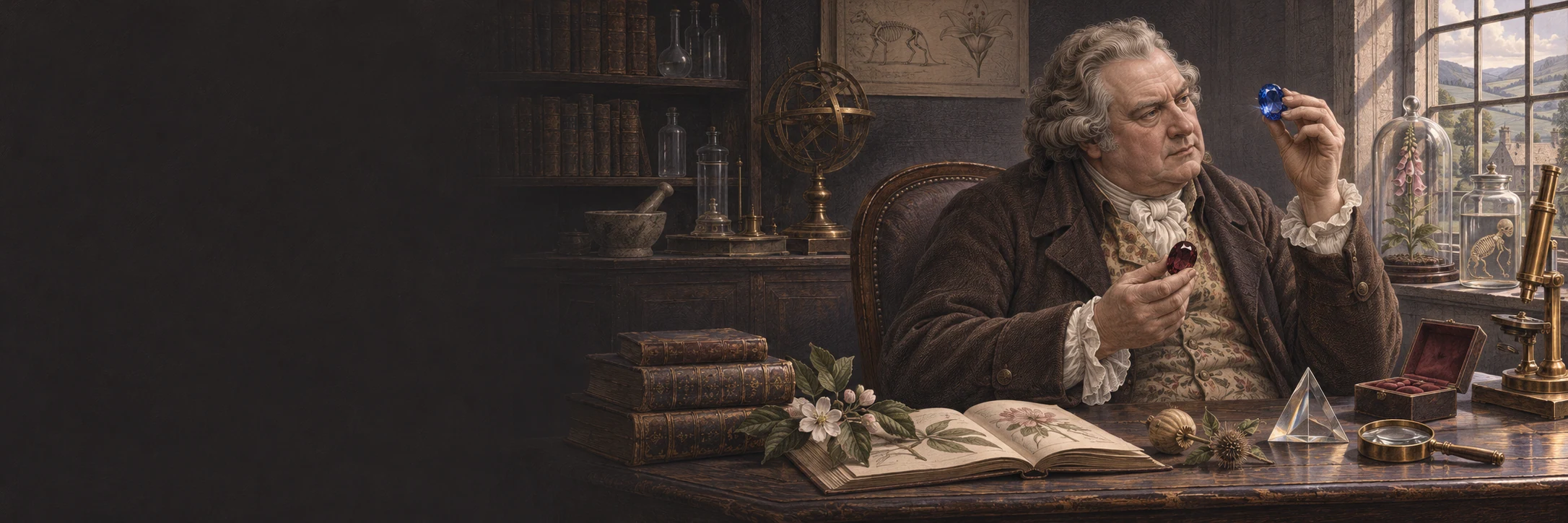
Erasmus Darwin (1731–1802), an English physician and poet, found a place for stones in his teaching poem The Botanic Garden. Each kind of stone gets something to do that a reader can almost see on its surface. Agates weave coloured threads. Flecks of light move so swiftly across an opal that Darwin lets it roll its eyes. This little company ends with three gemstones whose brilliance grows more intense in the space of a single couplet.
From playing light to a blush
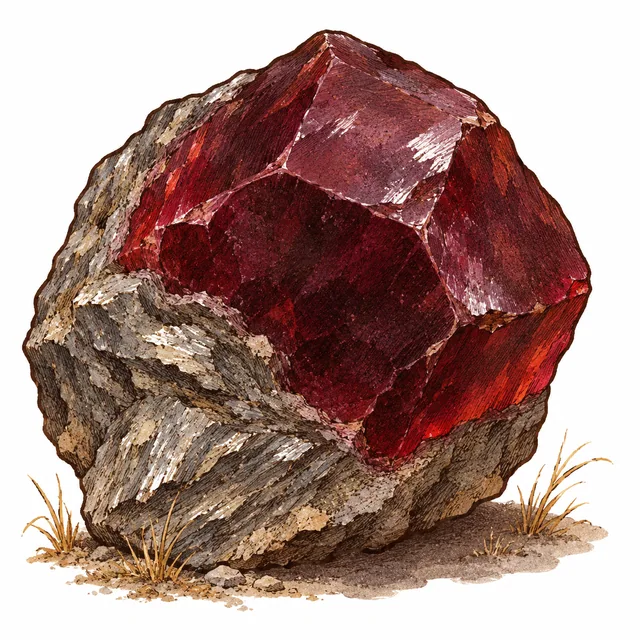
Around the sapphire, light still seems to move outside the stone. The preposition “around” leaves room between the object and the blue flicker that surrounds it. With the ruby the colour moves closer to a body. When someone blushes, colour rises in the face. The sight of the red stone has given Darwin a small human event. With the third image even that distance disappears. The diamonds themselves blaze, and in the middle of the line the poet calls them “living”.
Blue lambent light around the Sapphire plays,
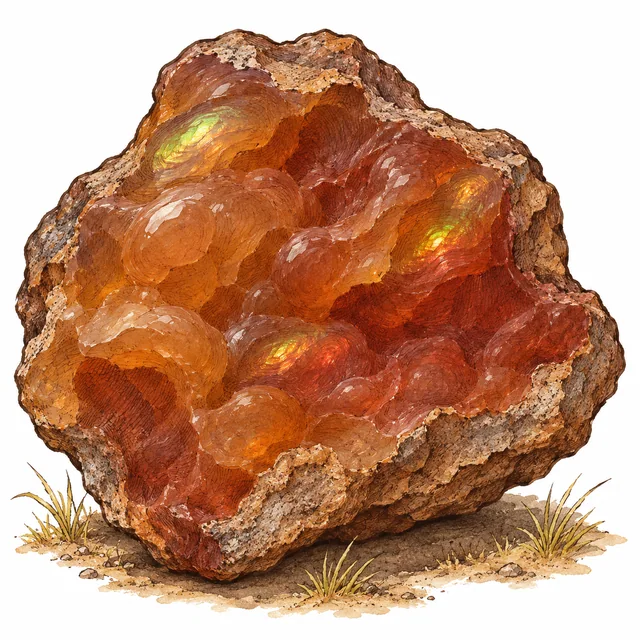
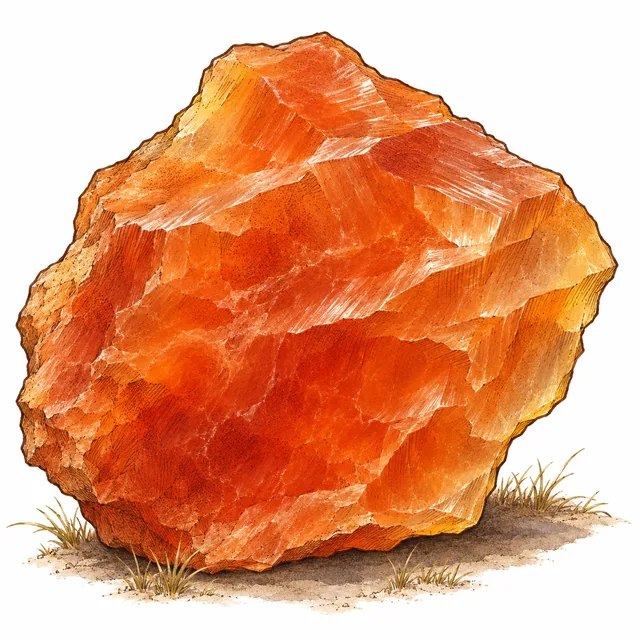
Bright Rubies blush, and living Diamonds blaze.
– Erasmus Darwin, The Botanic Garden, 1798, p. 50.[1]
A footnote to the fire
Darwin could have let the couplet stand on its own. Instead he devoted a substantial note to its final phrase. Following it to the foot of the printed page takes us to the refraction and reflection of light, the transparency of a diamond and the question of whether it burns. Darwin explicitly compares its effect on the eye with that of an artificial stone made of glass. Something that looks like fire has led him to ask what it is that an observer can actually see. The verse gives the stones a lively part to play. In the note we can meet the author again, this time as a natural investigator looking at the very same brilliance.

 Phone: +43 677 628 66 628 |


 Search
 The Theatre of Terrestrial Astronomy · XII · 1893 · p. 142
 Cart