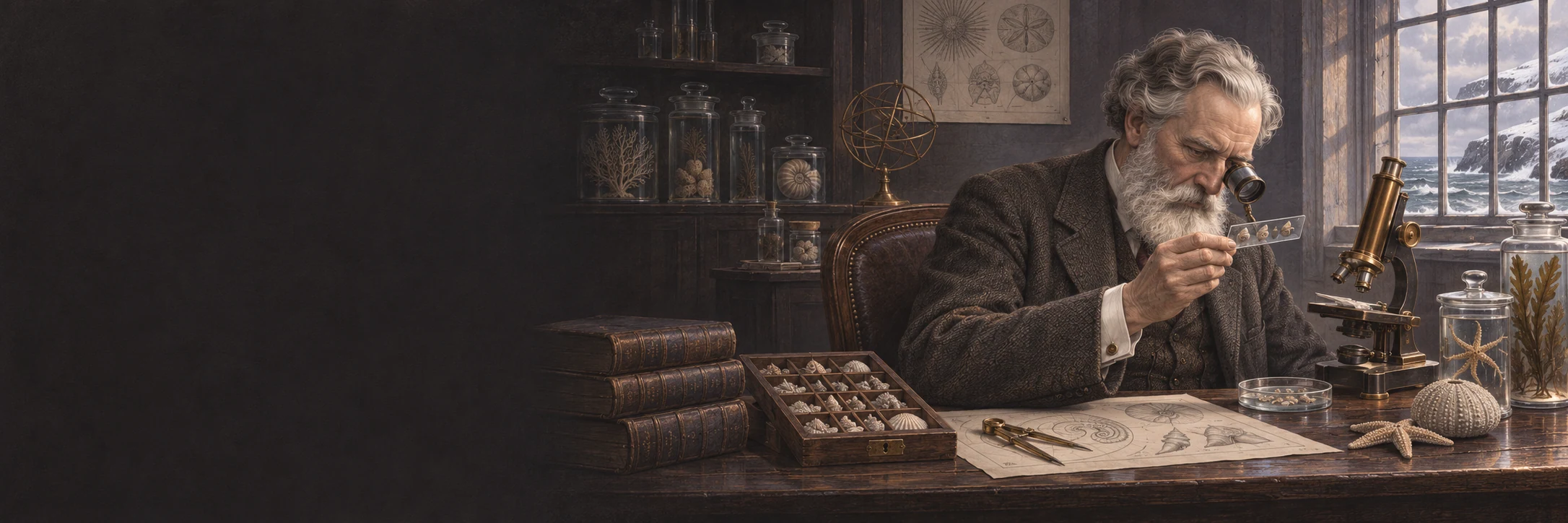
The Scottish zoologist D’Arcy Wentworth Thompson (1860–1948) brings the earth’s first snowfall into On Growth and Form while looking at a very different collection. His chapter concerns the minute shells of foraminifera, single-celled organisms whose shells also survive as fossils. Some are round, others elongated, and many consist of successive chambers. Set out side by side on a plate, they invite the eye to travel from the simplest to the most elaborate and to imagine that it has travelled forward in time.
Two ways of reading a series
Thompson asks his reader to consider a sphere, a cylinder and an ellipsoid. A mathematician can arrange them according to the complexity of their forms. That arrangement tells us nothing about their ages. A similar distinction matters when we look at shells. Two forms drawn next to each other may have an unmistakable geometrical kinship. To discover whether one creature descended from the other, we would need evidence of a different kind.
A snow-crystal is the same to-day as when the first snows fell.
– D’Arcy Wentworth Thompson, On Growth and Form, 1917, p. 611.[1]
What persists when a crystal melts
The snow crystal makes the distinction almost tangible. An individual crystal vanishes as soon as it melts. What could it mean, then, to call a modern crystal the same as one in the first snowfall? Water under comparable conditions could take a recognisable form then, just as it can today. Thompson returns from the snow to foraminifera in the Cretaceous seas. He wants to know how far the physical forces acting on such small bodies can account for the shapes of their shells. Wherever those forces suffice, an elegant series of drawings gives us a pattern. To turn that pattern into a family history requires another step.

 Phone: +43 677 628 66 628 |


 Search

 Meister Eckharts mystische Schriften. In unsere Sprache übertragen von Gustav Landauer · p. 126



 Cart