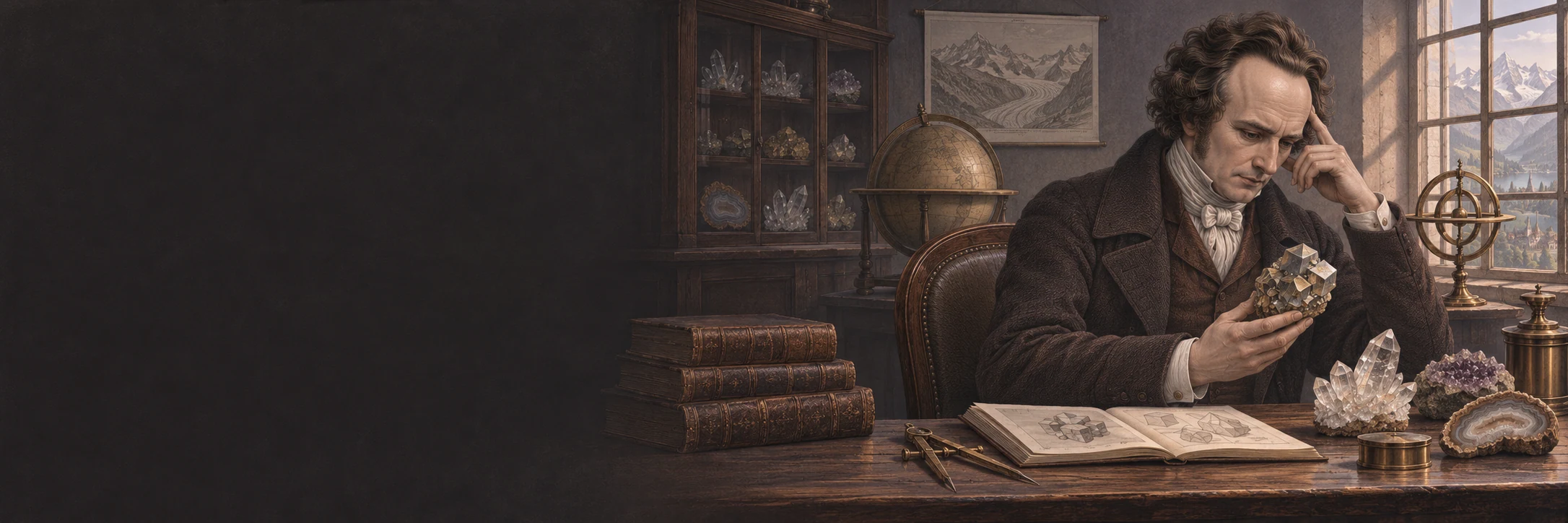
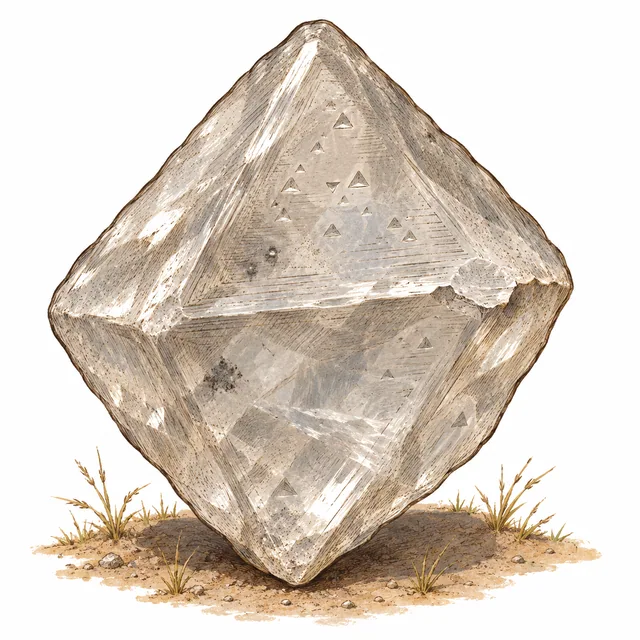
Lorenz Oken (1779–1851) was a German naturalist. In his Lehrbuch der Naturphilosophie he starts from a feature of crystals that is easy to miss in a cabinet full of large specimens. Under a microscope a crystal may already display its fully developed form. What gives so small a body this completeness? To make sense of it Oken asks his reader to think about the relation between the Earth and the Sun, then to return to the object under the lens.
What makes a centre?
A crystal is an entire celestial body. It is determined by central forces, which are in turn awakened and guided by forces that divide, by forces of light.
– Lorenz Oken, Lehrbuch der Naturphilosophie, 1831, p. 82.[1]
One way to imagine a crystal growing is to start at its core and work outwards, adding layer after layer. Oken asks how we could identify the starting point as a centre in the first place. To put a finger on the centre of a circle drawn on paper, we take our bearings from the line that runs around it. Core and outer boundary stand in a comparable relation in Oken’s account. Each helps determine what the other is.
A question of scale
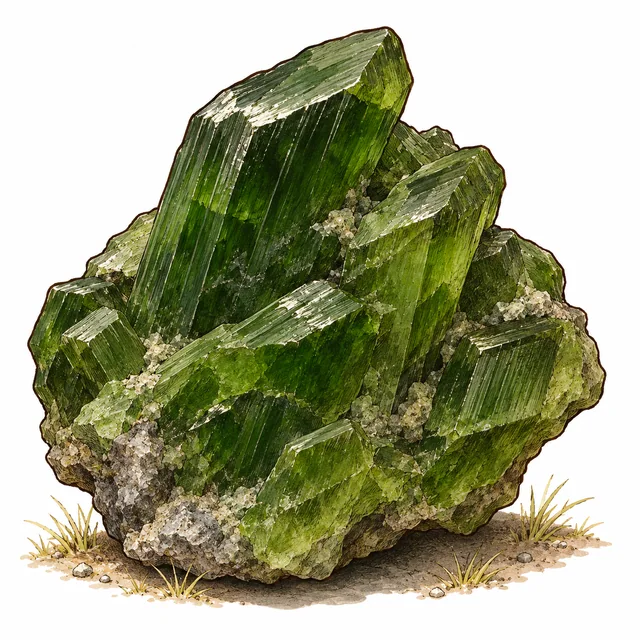
The Sun enters his argument because its place as the centre of a system depends, in his example, on a planet standing in relation to it. This brings out the force of the word entire. A minute crystal can already be whole when the relations between its parts are complete. Oken’s forces of light belong to his historical system of natural philosophy. His opening observation is within anyone’s reach: a crystal tip barely visible to the eye can repeat the angles and edges of a specimen big enough to fill the palm.

 Phone: +43 677 628 66 628 |


 Search
 The Theatre of Terrestrial Astronomy · XII · 1893 · p. 142


 Cart