
 Phone: +43 677 628 66 628 |


William Shakespeare
And this our life exempt from public haunt Finds tongues in trees, books in the running brooks, Sermons in stones and good in every thing.
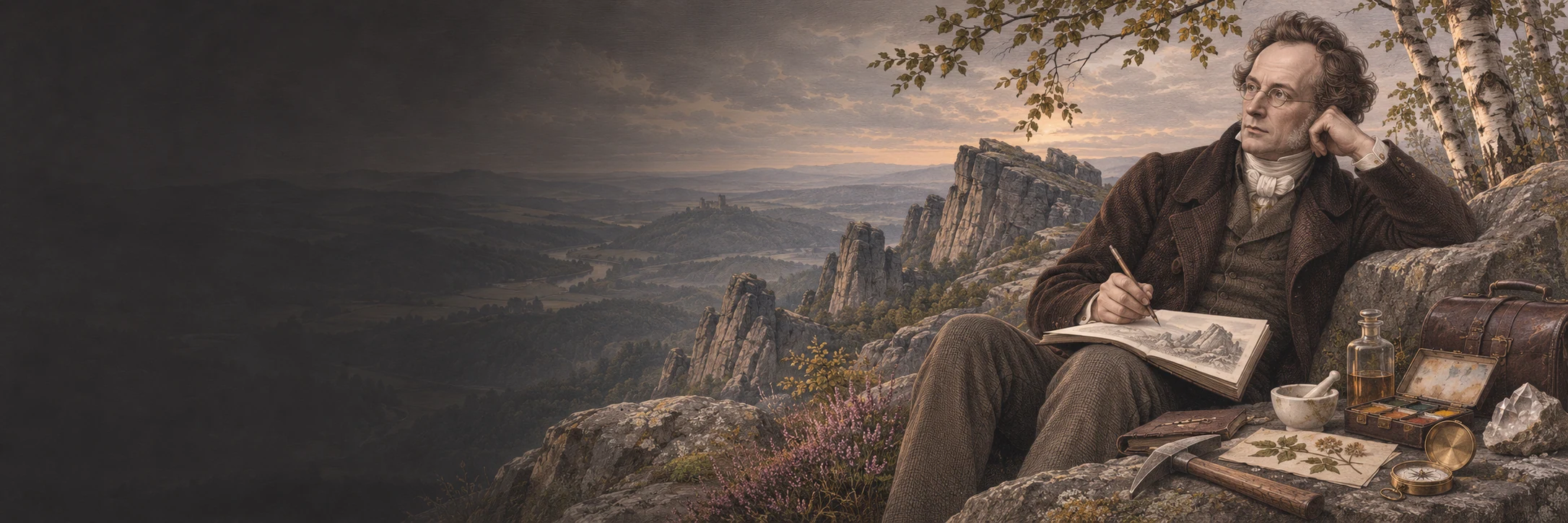
Carl Gustav Carus (1789–1869) was a German physician, naturalist and landscape painter. A cliff face would have served him well to illustrate a question in Natur und Idee. You can break off a piece of rock and hold it up on its own. But where was its boundary before you broke it off? A crystal poses the question differently. Its faces may already show, within the surrounding rock, how far this particular body extends. For Carus the difference bears on what it means for a living creature to be an individual.
The first thing within the mass of the solid earth that foreshadows and prepares the way for the individual life of creatures later to inhabit its surface is the crystal.
– Carl Gustav Carus, Natur und Idee oder das Werdende und sein Gesetz, 1861, p. 178.[1]
Carus’s unusual German term Erdveste means the solid body of the Earth. His “epitelluric” creatures live on its surface. Across a single page he moves between three scales: the planet taken as a whole, a crystal within its mass, and the many individual beings that live on its surface. He assumes that the approach of organic life must already be discernible where the materials in view are still those of geology. The crystal earns its place here because its characteristic shape can be picked out.
Carus recalls a difficulty he attributes to contemporary mineralogists. Examining the chemical constituents of a rock had yielded conflicting answers about what to count as a unit. A well-formed crystal offered something observers could point to together. At that point Carus takes a step beyond mineral description. The shape that a mineralogist can identify as a single specimen becomes, for him, an early intimation of individuality. The same crystal invites two quite distinct questions.
 Search
And this our life exempt from public haunt Finds tongues in trees, books in the running brooks, Sermons in stones and good in every thing.
And so the diamond would have the loveliest of all these little souls, the cut diamond even one shaped and ennobled by education; loveliest of all if it is the diamond on the finger of a woman who has a still higher and lovelier soul in the head above it.
Gustav Theodor Fechner (1801–1887)
 Die Tagesansicht gegenüber der Nachtansicht · p. 87
Our translation
The soul is a crystal, the Godhead is its light: The body in which you live is the shrine of both.
Angelus Silesius (1624–1677)
Des Angelus Silesius Cherubinischer Wandersmann · p. 75
Our translation
My soul now resembles a crystal That no false ray of light has yet struck; […]
[…] I am earth and air in one; part of that blue heaven which you love, and long for, is already in me […]
[…] the curse of all the heart-aches and blasted hopes had made its every stone thirsty and hungry […]
Rabindranath Tagore (1861–1941)
The Hungry Stones and Other Stories · p. 23–24
Historical English translation, 1916 · excerpt
The primordial crystal is the diamond of the earth, in which every eye delights, recognising it as the first-born son of light and gravity.
Georg Wilhelm Friedrich Hegel (1770–1831)
Vorlesungen über die Naturphilosophie · p. 280
Our translation
I walked on, waking the living, warm breaths; and the jewels looked, and wings rose without a sound.
I am beautiful, mortals, like a dream of stone, And my breast, on which each in turn has bruised himself, Is made to inspire in the poet a love As eternal and mute as matter.
The secret strength of things Which governs thought, and to the infinite dome Of heaven is as a law, inhabits thee!
Percy Bysshe Shelley (1792–1822)
The Poetical Works of Percy Bysshe Shelley, III · p. 33
Original wording
Marvellous stone and marvellous water! With good reason it surpasses rivers and stones, for it flows and is a stone.
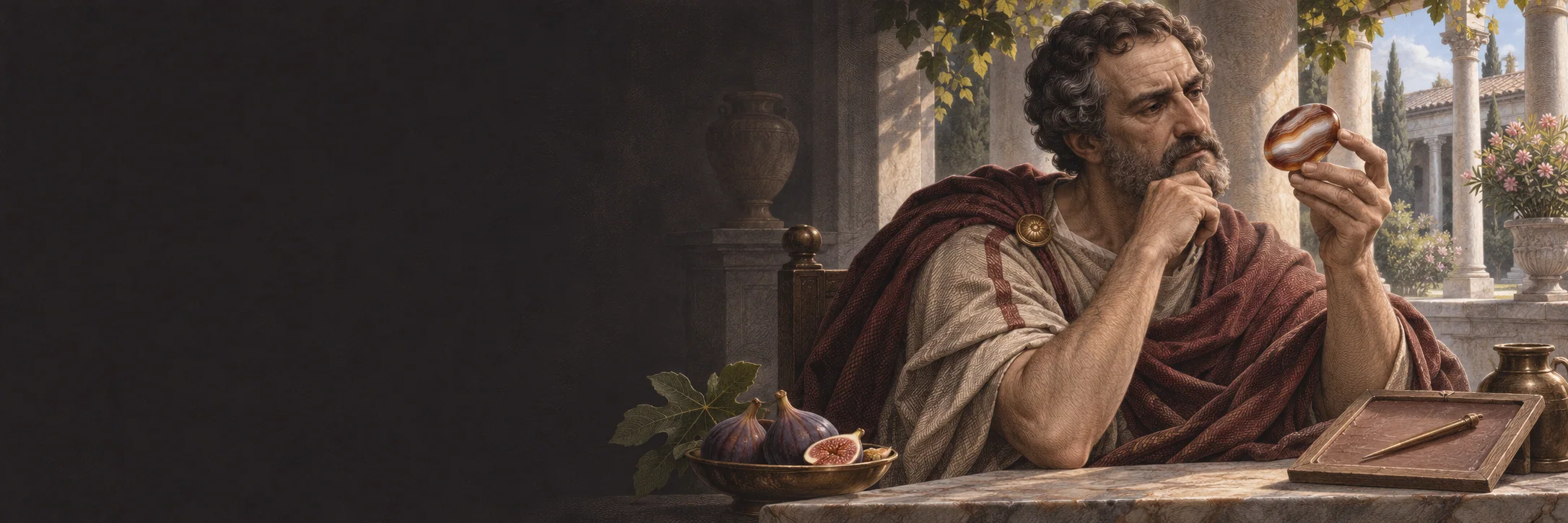
For he is said to have owned an agate in which the nine Muses and Apollo playing the lyre could be seen, not by art but because the markings naturally distinguished themselves so well that even the individual Muses had their own attributes.
Pliny the Elder (23/24–79)
C. Plini Secundi Naturalis historiae libri XXXVII, V · p. 382
Our translation
 Cart