The First Book of Kings, part of the Hebrew Bible, describes the building of the temple under Solomon in its sixth chapter. One could draw a plan from this account. The writer also attends to something difficult to show on a ground plan. What happens to the impression of the building when a person steps inside? A visitor can know that this is a stone house while seeing no stone anywhere.
Timber in front of masonry
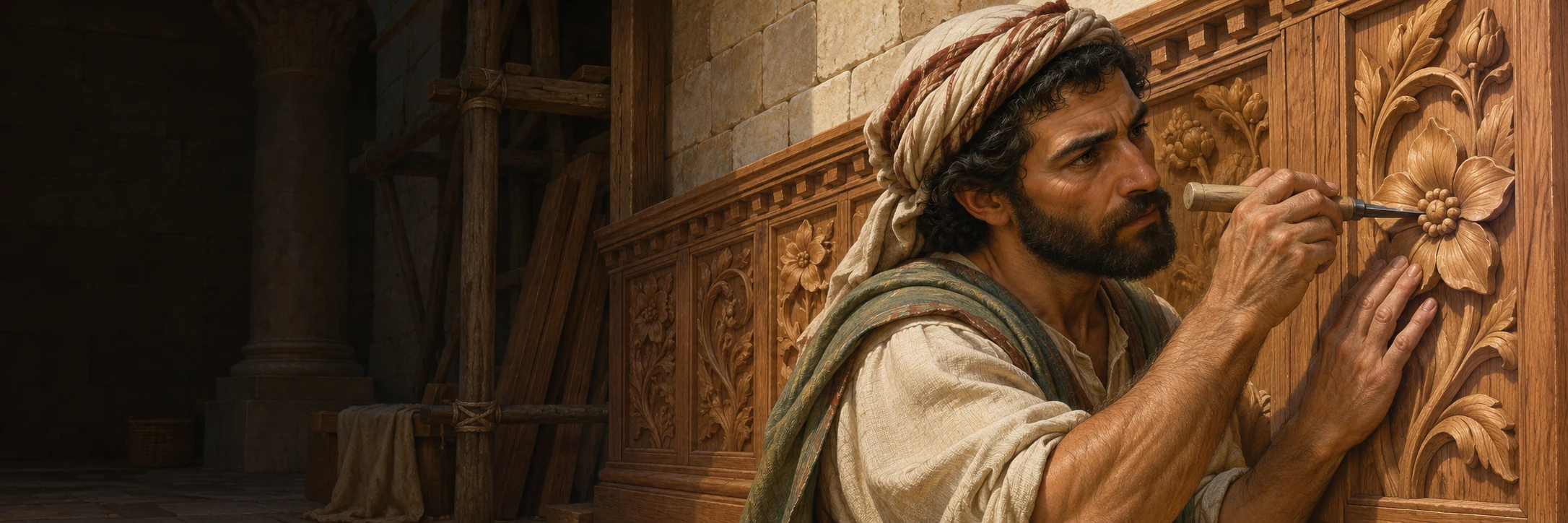
Inside, the whole house was cedar, with carved knobs and flower-work, so that no stone could be seen.
– First Book of Kings, The Bible, 1922, p. 358.[1]
The verse follows the eye of someone in the room. What it encounters is cedar. Panelling covers the walls, and the carver has worked with the material of the boards. The transition from a plank to an image is gradual. The same wood that a hand might follow across a smooth surface rises into a blossom a little further along. Light and shade allow the ornament to stand out even when carving and background have exactly the same colour.
A plant becomes material and image
The cedar was once a tree. Inside the temple it serves both as building material and as the bearer of new plant forms. Further on the account mentions palms as well as open flowers. The interior acquires a character quite different from the stone exterior. The masonry continues to support the walls. To a visitor, however, the room consists of what the eye and hand can encounter there. The stone that has disappeared from sight therefore deserves its place in the sentence. Knowing it is there makes it possible to appreciate how completely the timber has transformed the space.

 Phone: +43 677 628 66 628 |


 Search

 Etymologiae · 1911 · XVI, 14, 2

 Cart