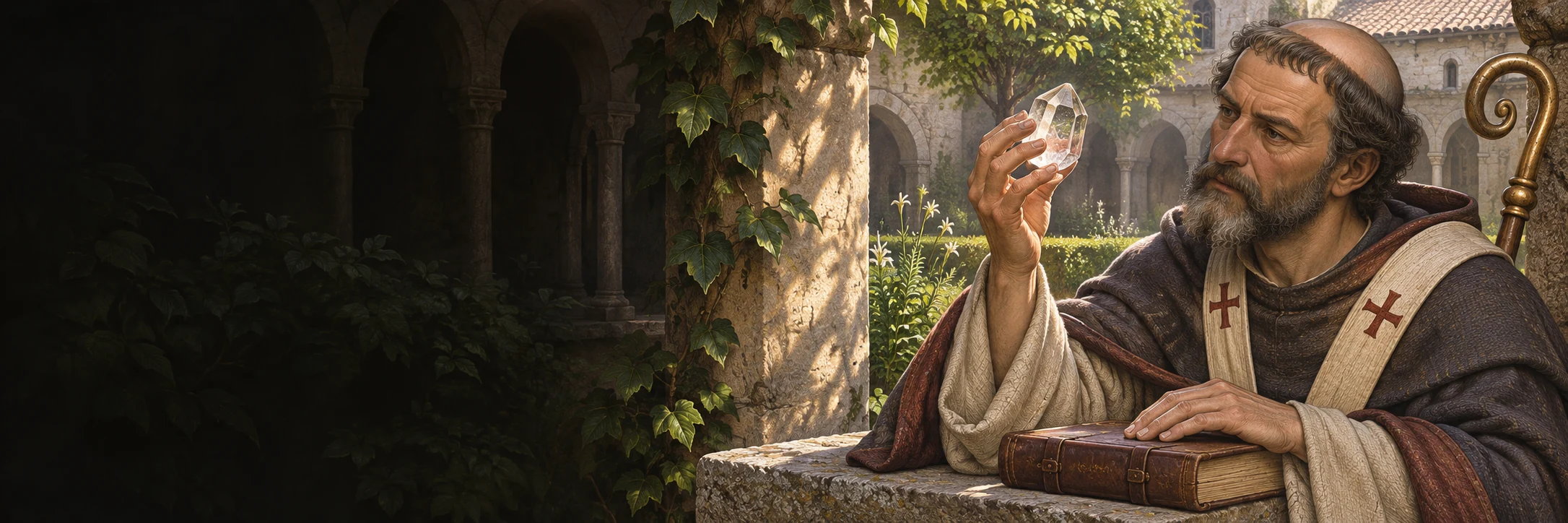
Marbod of Rennes (c. 1035–1123), a French poet and bishop, discusses rock crystal in his Latin poem about precious stones. His entry opens with a disagreement. Some take crystal to be the product of intense cold. Others point out that it is found in lands where a severe winter would be an unlikely explanation. When Marbod turns to its next property, his tone changes. Here he thinks he can appeal to something that can actually be shown.
Sunlight, a stone and tinder
[…] that this stone, placed in the sun, takes fire and with it will kindle tinder fungus brought up close.
– Marbod of Rennes, Liber lapidum, 1799, p. 70–71.[1]
Three things must occupy the right positions. Sunlight has to reach the stone, and tinder must be brought close enough to catch fire. The Latin verb for receiving briefly makes the crystal an agent. It takes a place between the distant sun and an inconspicuous piece of tinder. By the end of the process a visible change has occurred in that small object. The short lines bring the long journey of the light and the tiny site of its effect unusually close together.
What can be demonstrated
Marbod puts particular weight on different degrees of certainty. Nobody can describe the origin of an individual crystal as an eyewitness to its formation. With a suitable specimen, a clear day and combustible material, however, an observer can repeat an event. The account turns on that distinction. The stone whose name and supposed origin had called up the image of ice becomes recognizable to the reader through its ability to produce fire.

 Phone: +43 677 628 66 628 |


 Search

 Meister Eckharts mystische Schriften. In unsere Sprache übertragen von Gustav Landauer · p. 126











 Cart