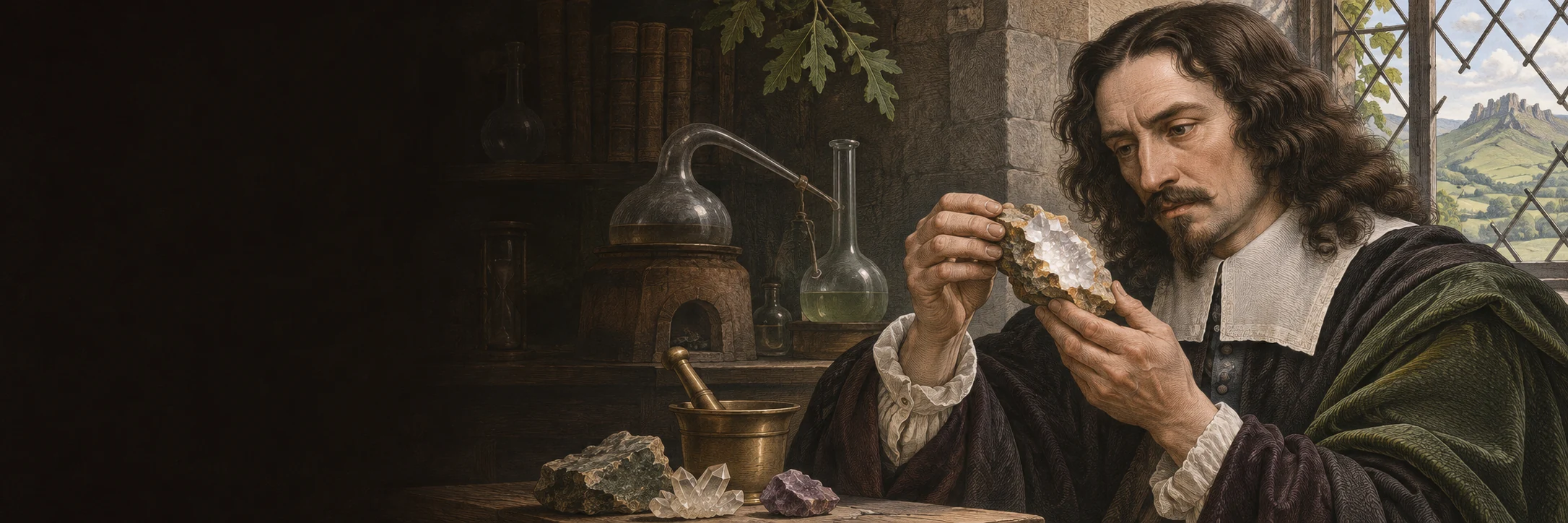
Thomas Vaughan (1621–1666), a Welsh alchemist and writer, distinguishes the outward appearance of a body from what he believes participates in the making of new forms within it. His examples in Aula Lucis include earth, water, stones and human beings. None of them displays the principle he seeks plainly on its surface. He therefore uses a comparison to help readers understand what they are looking for in the first place.
An unusual word for the interior
All these things have a lumpish, ineffectual outside, but inwardly they are full of a subtil, vital limositie impregnated with fire, and this nature makes use of in generations, wherefore wee call it the sperm […].
– Thomas Vaughan, Aula Lucis, 1652, p. 12.[1]
Vaughan’s word is limositie. Here it refers to the muddy or slimy character of a subtle matter. His mention of fire joins two impressions the hand would find difficult to grasp at once. One suggests moisture and the ability to take a shape, the other warmth and activity. Vaughan expects their conjunction to help explain how something new can come into being. When he speaks of seed in the next sentence, he explicitly takes up that question of generation.
A body and its seed
A human being supplies his clearest example of the distinction. The body can be seen and its outlines described. What gives rise to further life is nevertheless distinguishable from the body as a whole. By the same reasoning Vaughan distinguishes the visible fabric of the world from what he thinks makes formation possible within it. The emphasis falls on a change in the observer’s question. Weight and outline describe the outward form of a stone. Following Vaughan means asking a second question about the hidden material that, in this author’s view, participated in making it.

 Phone: +43 677 628 66 628 |


 Search

 Meister Eckharts mystische Schriften. In unsere Sprache übertragen von Gustav Landauer · p. 126

 Cart