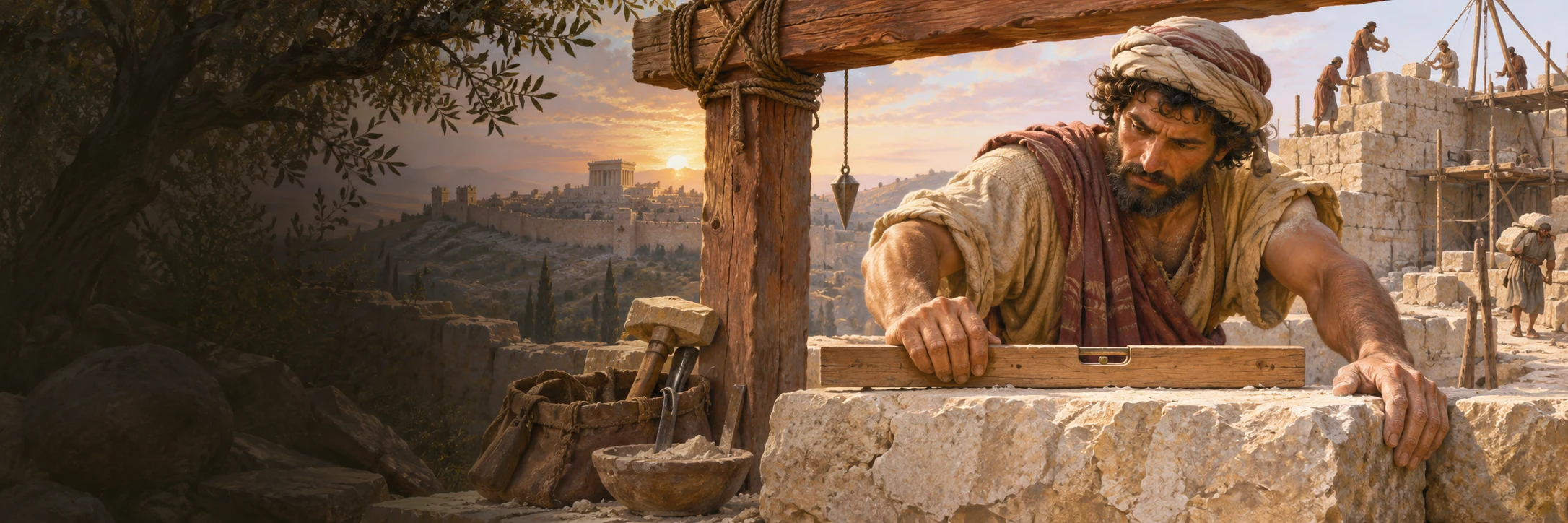
The Hebrew book of Habakkuk gives a prophet the task of speaking about injustice embodied in a house. A person who has acquired security at someone else’s expense wants to make that security last. A thick wall serves the purpose well. It turns away inquisitive eyes and separates the people outside from those who live within. In the second chapter this very protection acquires the unexpected authority of a witness.
What a house can disclose
For even the stones in the wall will cry out, and the rafters in the timberwork will answer them.
– Book of Habakkuk, The Bible, 1922, p. 889.[1]
A stone belongs to the house because someone carried it there and set it in place. When it calls out from the wall, the labour and the history of that act begin to matter. The finished surface of a building generally tells us little about who paid for its materials or in what circumstances they were used. In the prophet’s saying the hidden history becomes audible. Its voice comes from inside the possession the owner thought he had secured for himself.
Two voices in one building
The timber answers the stone. A reader can imagine the call travelling from the masonry to the roof. Two different materials support the same testimony, much as two human witnesses might. The accusation concerns the person who founded his house on injustice. Stone and wood receive the power to tell how that happened. It is a striking image of memory attached to a place. A building may outlast its owner’s willingness to speak about the circumstances in which it rose.

 Phone: +43 677 628 66 628 |


 Search

 Meister Eckharts mystische Schriften. In unsere Sprache übertragen von Gustav Landauer · p. 126

















 Cart