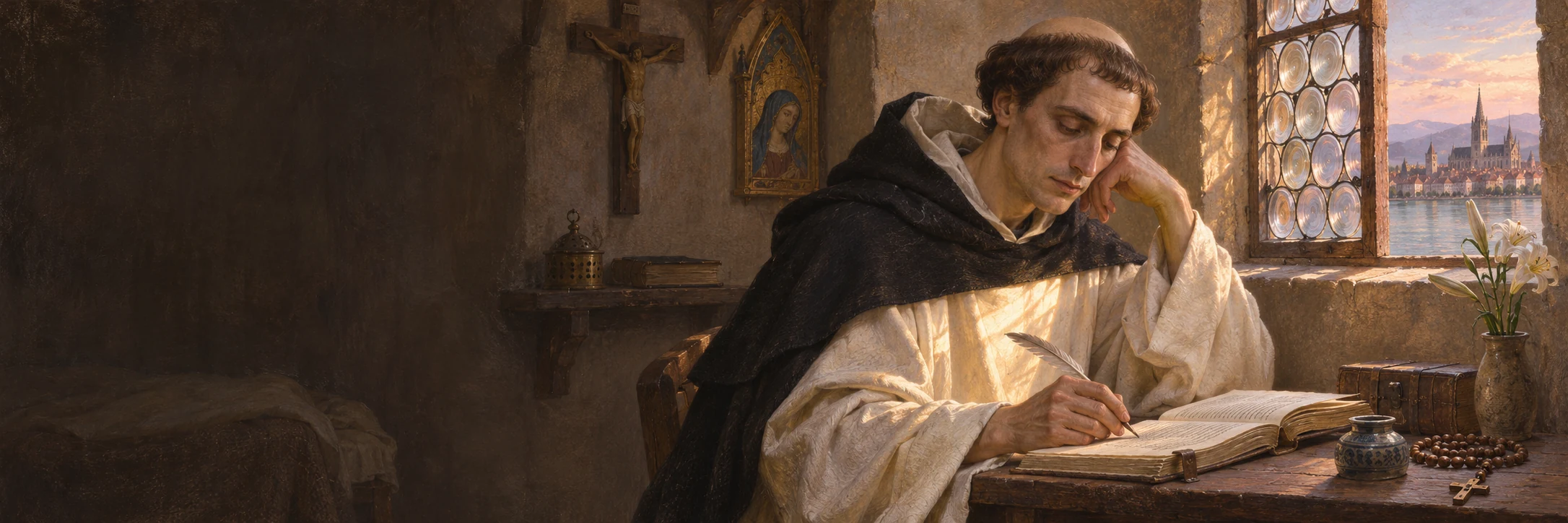
Henry Suso (c. 1295–1366), a German-speaking Dominican from the Lake Constance region, describes in his Life an inward experience remembered as something seen. The narrative speaks of the Servant of Eternal Wisdom in the third person. A reader can therefore follow him in the act of looking. The curious question is how a person can see something that the ordinary human body hides even from its own possessor.
Looking at the breast
He looked immediately, and saw that his body over his heart was clear as crystal, and that in the centre of his heart was sitting tranquilly, in lovely form, the Eternal Wisdom; beside whom there sat, full of heavenly longing, the Servitor’s soul, which, leaning lovingly towards God’s side, and encircled by God’s arms, and pressed close to His divine heart, lay thus entranced and drowned in love in the arms of the beloved God.
– Henry Suso, Life of the Servitor, 1865, p. 27.[1]
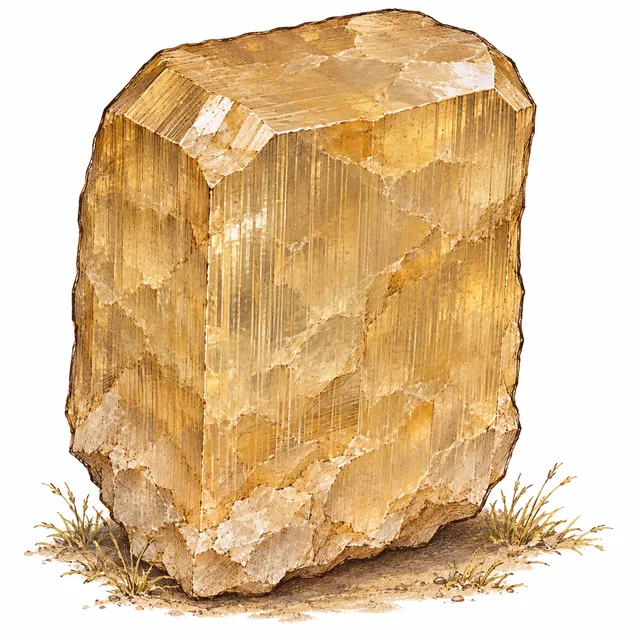
In the experience described here, the flesh over the heart acquires a property of crystal. The body retains its position and form. What gives way is the obstacle it usually presents to the eye. This explains the precision of the comparison. An opening in the breast would suggest an injury. A crystalline surface can remain perfectly continuous while allowing a viewer to see what lies behind it. The gaze reaches the interior without breaking up the figure of the person we have been asked to imagine.
Reading the image a second time
The heart is where the Servant understands his devotion to God to reside. Suso gives that relationship a physical nearness that a reader might almost measure with a hand. The hardness and clarity of a mineral help to convey an experience of the vulnerable human body. Much of the force of the scene lies in this change of sensory expectation. Someone looking at a surface discovers that the matter of real interest lies just beyond it. Crystal keeps both parts of that discovery within the same image.

 Phone: +43 677 628 66 628 |


 Search
 The Theatre of Terrestrial Astronomy · XII · 1893 · p. 142




 Cart