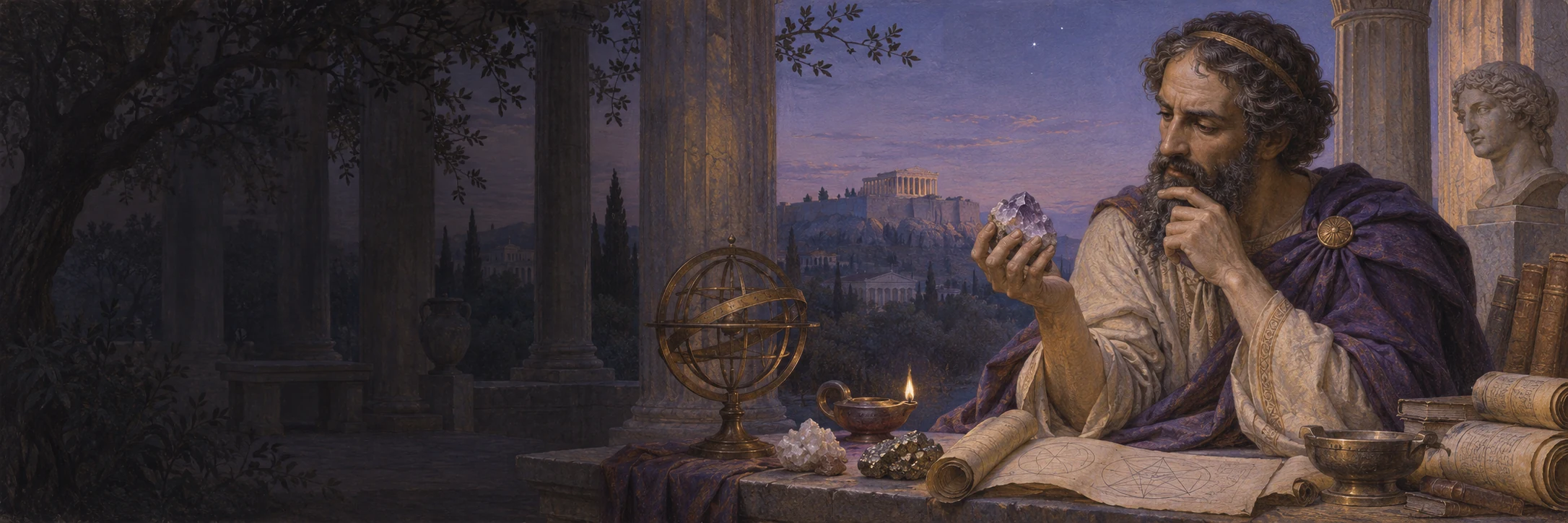
Proclus (412–485) was a Greek philosopher of late antiquity who taught in Athens. In a short work on priestly practice he asks how people can recognise a connection between things on earth and the heavenly bodies. His starting points are familiar to anyone who spends time outside. One flower follows the sun. Another opens when the moon comes up. For Proclus a person who notices these correspondences in time can see something of the distant luminary at work in a plant close at hand.
A breath between earth and sky
Even stones may be seen breathing in the emanations of the luminaries. […]
– Proclus, On the Hieratic Art, 1928, p. 149.[1]
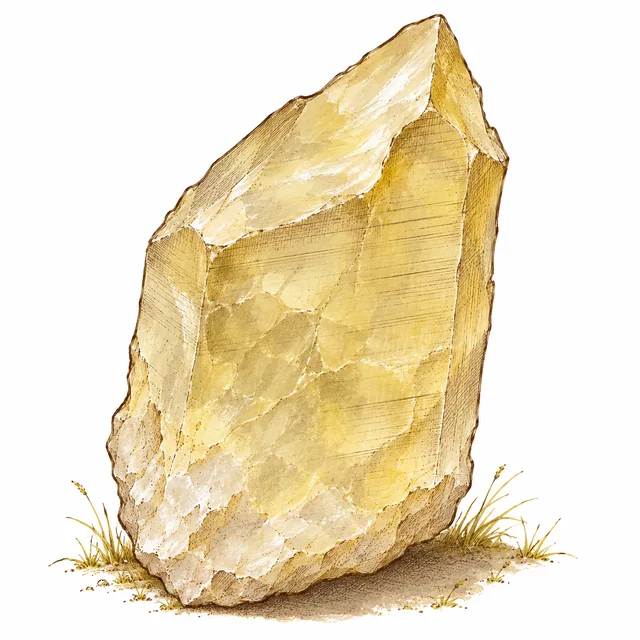
A stone presents a harder case. It has no leaves to turn towards the light. Proclus describes it instead as drawing breath. The image makes the boundary of a solid body permeable. Something that comes to it from the heavens continues to act within it. Among his examples is the sunstone, whose golden rays resemble the rays of the visible sun. A small bright surface on earth thus gives the observer reason to think across an immense distance.
Reading kinship in a glint
The sequence also explains why the essay proceeds from looking at things to using them in a religious act. For somebody choosing an offering or an object for a rite, resemblance has practical consequences. Different materials can belong together because each points towards the same heavenly power. A stone acquires a particular value when someone recognises that relationship. The glint seen in turning the sunstone towards the light has its place beside the flowers and celestial bodies with which Proclus began.

 Phone: +43 677 628 66 628 |


 Search
 Epistolae · o. J. · p. 353







 Cart