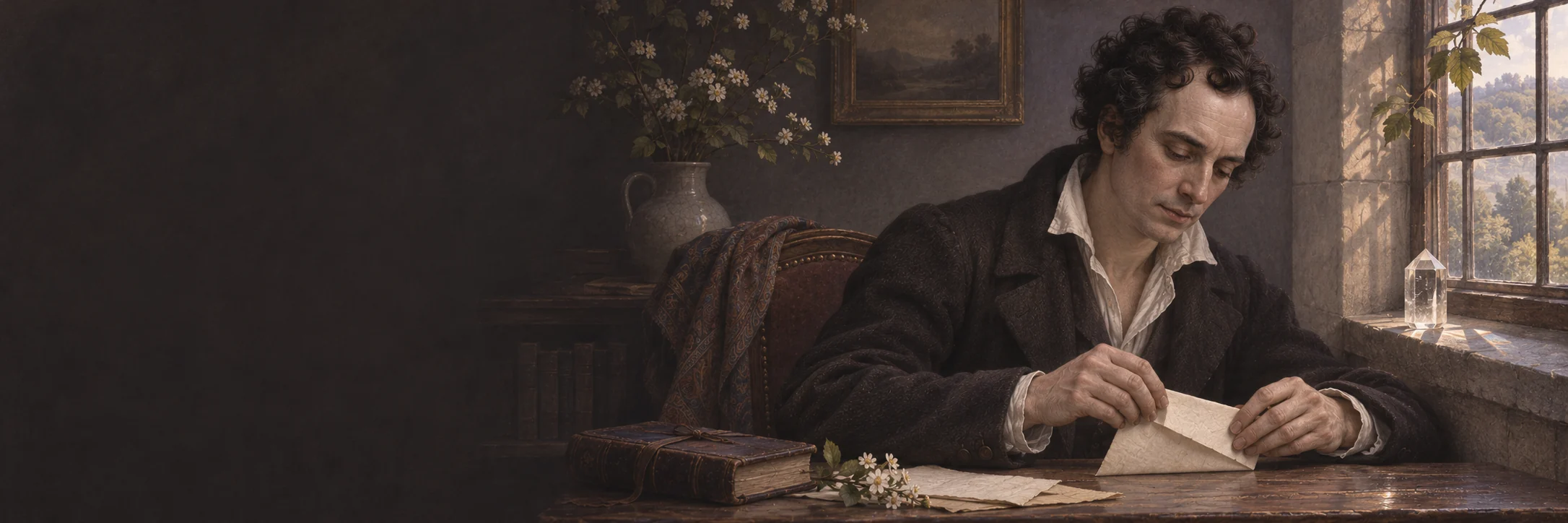
Bettina von Arnim (1785–1859) was a German writer. In 1844 she published the Frühlingskranz, drawn from the youthful correspondence between her brother Clemens Brentano and herself. The sentence about a crystal belongs to a letter presented in the book as his. Clemens is writing to Bettine from a cold room. His stove smokes, the winter weighs on him, and his friend Savigny receives his confidences with a silence he struggles to understand. Small wonder that his sister’s letters cheer him.
Clemens waits for an answer
Purity of soul in dealing with others, without premeditation or calculation, is alone the bright crystal through which life is understood in its original character. From itself it continually renews the enduring motives that can turn a troubled world about and restore its original strength.
– Clemens Brentano, Clemens Brentanos Frühlingskranz, 1844, p. 110.[1]
He wants to hear what crosses her mind as she reads. Even when she is reluctant to read a book to the end, she can tell him about the feelings it has awakened. Almost imperceptibly the letter turns towards a question about seeing. What kind of attention allows a person to get beyond a first impression? Clemens finds an image for it in a bright crystal through which something else can be seen.
Clarity in dealing with others
The German word Verkehr here means dealings with other people. For Clemens the openness of a gaze has something to do with conduct. Someone calculating the effect of every word in advance may see chiefly the answer he expects. When calculation falls away, the encounter can still come as a surprise. The setting in a letter gives the thought particular weight. What Clemens wants from Bettine is a reply whose contents he can neither plan nor foresee.

 Phone: +43 677 628 66 628 |


 Search

 The Composition of the World · 1858 · p. 109





















 Cart