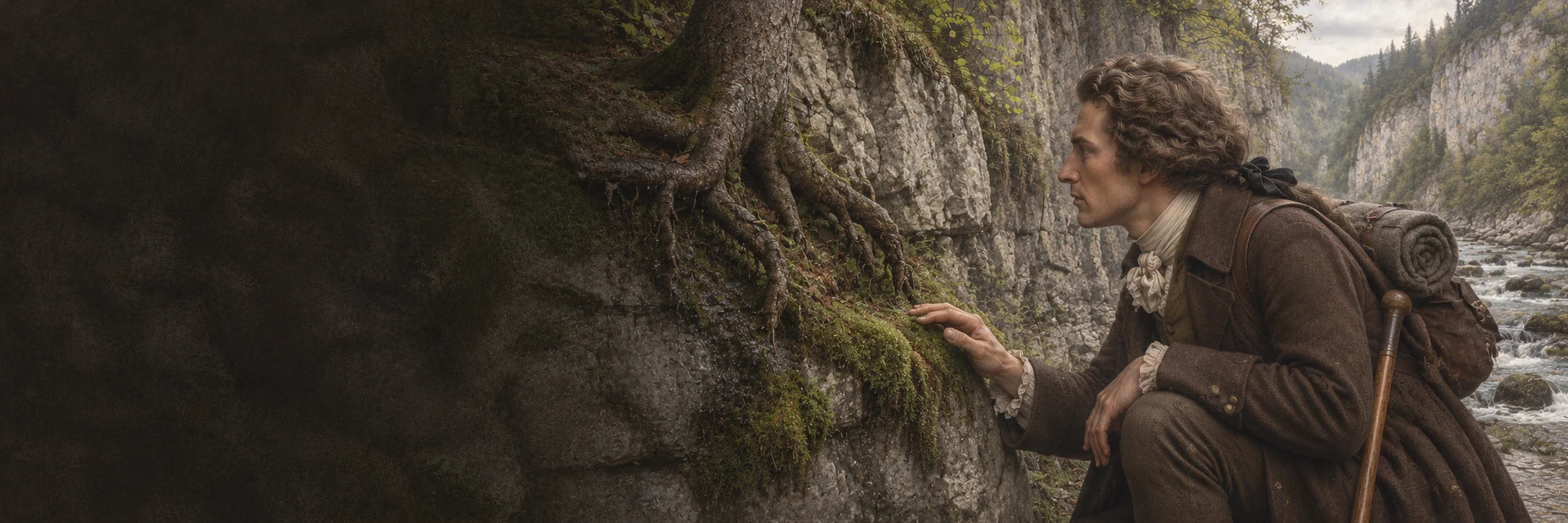
Johann Wolfgang von Goethe (1749–1832) was a German poet and naturalist. In a travel letter from the Swiss Jura in the autumn of 1779, he describes a road through a gorge of the Birs. The traveller sees a stretch of river, the narrow road and the high walls only as far as the next bend. Goethe stops when he comes out of the gorge. He tries to picture the shapes between which he had felt so tightly enclosed while walking. Looking back in this way draws his attention to the vegetation on the rock.
A foothold for a spruce
The vegetation holds its ground. On every ledge, surface and crevice spruces take root, and moss and kindred herbs fringe the rocks.
– Johann Wolfgang von Goethe, Letters from Switzerland, [1902], p. 143.[1]
A ledge, a level surface and a crevice offer the spruce quite different places to take root. Goethe names each feature of the ground before he names the tree. Following the sentence is like finding a shelf on the rock face with your eyes and only then noticing what grows on it. Moss runs along the surface like a fringe. A thin band of green makes the edge of the rock easier to see.
Reading time on a cliff face
At fresh breaks Goethe had noticed a different colour from that of the weathered faces. Corners are becoming rounded and the softer patches have been washed away. Beside these signs of gradual change grows a spruce whose roots have found a place in an existing crack. Both histories are visible on the same small patch of cliff. Goethe closes by singling out the road made by human hands. Someone passing through in a single afternoon can see traces of processes that extend far beyond the duration of the journey.

 Phone: +43 677 628 66 628 |


 Search

 Tiangong kaiwu · o. J. · Ch. 18, 珠玉, section 寶







 Cart