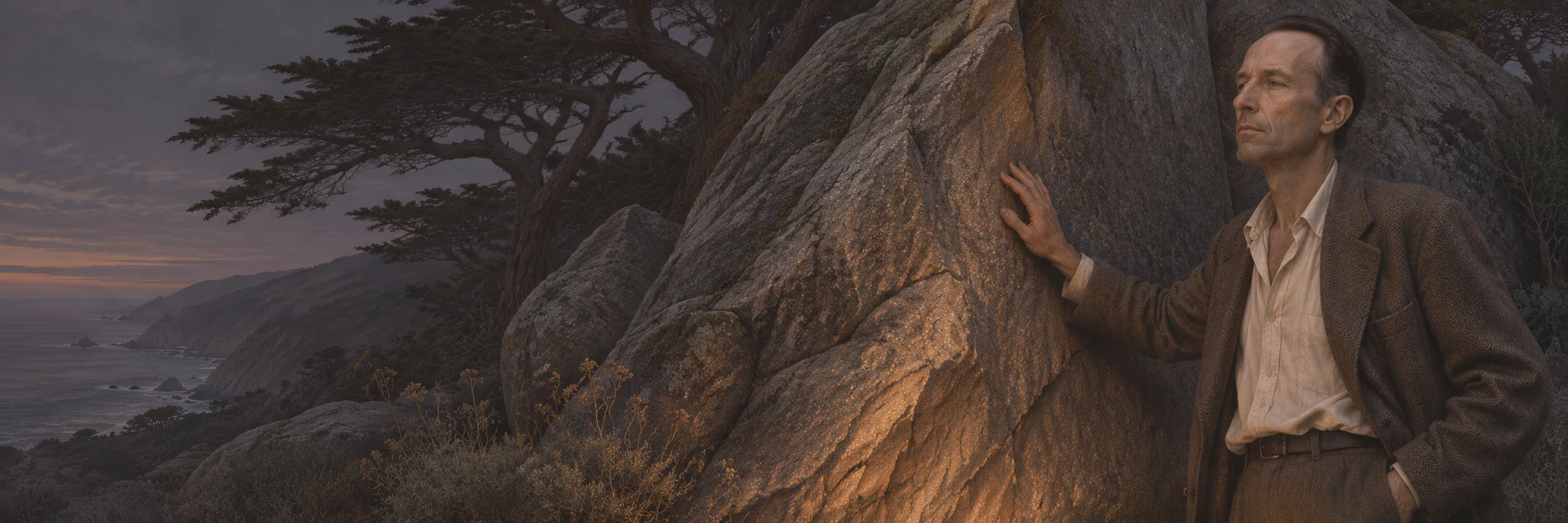
Robinson Jeffers (1887–1962), the American poet, recalls a night spent out of doors in Oh, Lovely Rock. His sons and their companions are asleep, while one man remains awake. The fire throws light on a wall of rock. There are few features to identify. The stone has a colour, a few slanting seams and a surface polished by water and by material sliding over it. Even the ferns and lichens that might ordinarily claim a watcher's attention are absent.
What the light reveals
[…] as if I were seeing through the flame-lit surface into the real and bodily
And living rock.
– Robinson Jeffers, Such Counsels You Gave to Me and Other Poems, 1937, Oh Lovely Rock, passage by the fire.[1]
The speaker knows rock well. That makes his impression of seeing it for the first time all the more striking. Firelight moves over the face while the wall itself stays still. For a moment he feels able to see through the lit surface. What he finds on the other side is once again rock. His word for its bodily presence matters. The thought that it might be alive comes just where the bare shape of stone has become most distinct to the eye.
After the watchers are gone
From this one night the father thinks ahead to his sons' lives and to a time when those lives too will have run their course. The wall gives that thought a place. We can imagine darkness gathering against it again and a different fire picking out its seams. What remains strange is the length of a history that continues quite outside the history of a family. For a few minutes a campfire makes it possible to hold both scales of time in view.

 Phone: +43 677 628 66 628 |


 Search

 The Composition of the World · 1858 · p. 109









 Cart