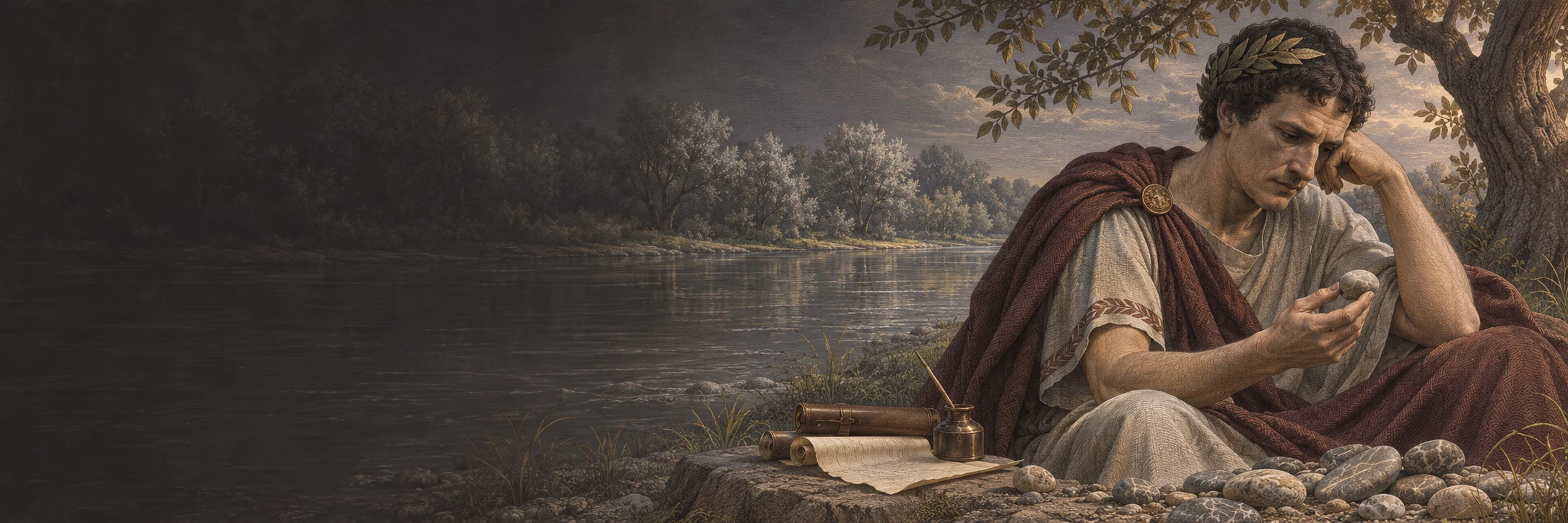
Carlos Drummond de Andrade (1902–1987) was a Brazilian poet. In the first printing of his poem about a stone in the road, the lines sit among the narrow columns of a magazine. The poem itself takes up little space. A quick glance gives the impression of reading the same sentence several times over. The writing catches a familiar experience. We may have set off down a road without much thought, only to remember it afterwards at the very spot where something interrupted our step or caught our eye.
The same words come round again
I shall never forget that in the middle of the road
there was a stone […]
– Carlos Drummond de Andrade, No meio do caminho, 1928, July, p. 1, ll. 7–8.[1]
Drummond says remarkably little about the obstacle. He gives us neither the size of the stone nor its colour. Nobody is seen to stumble, and we never hear whether anyone moved it out of the way. A handful of words keep changing places within the line instead. Sometimes the road comes first, sometimes the stone. Reading aloud makes the resulting change of expectation quite clear. Just when the phrase has grown familiar, the tongue has to negotiate the very same place once more.
What tired eyes remember
Only in the second part does the speaker speak explicitly about remembering. He refers the event to the lifetime of his tired eyes. An eye that has looked at things for years can easily pass over something in plain view. Here an ordinary object has made an impression that goes on shaping how the eye moves in retrospect. The poem lets us experience this ourselves. By the time we begin to wonder what the stone might stand for, its place in the middle of the road is already fixed in memory.

 Phone: +43 677 628 66 628 |



 Search

 Meister Eckharts mystische Schriften. In unsere Sprache übertragen von Gustav Landauer · p. 126






















 Cart