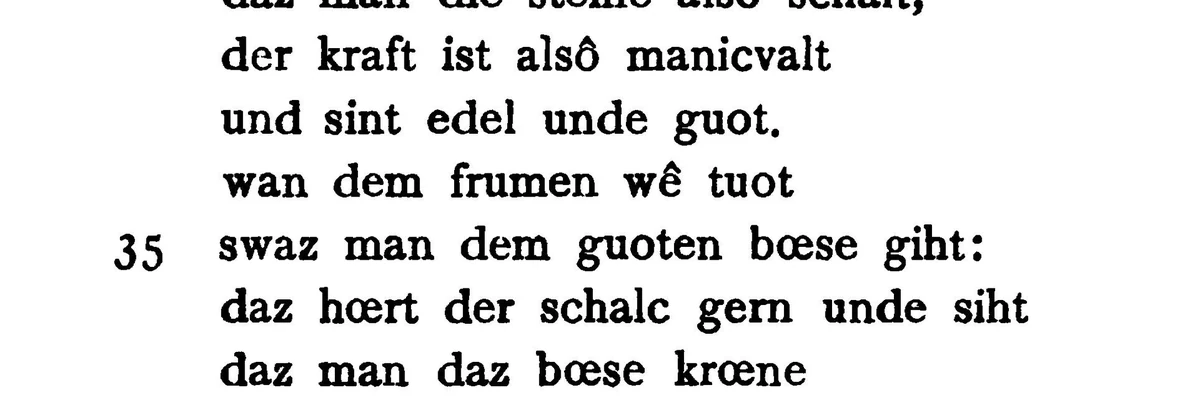
At the beginning of his Steinbuch, Volmar fiercely attacks a man who disparages gems and considers glass their equal.
“[…] and says out of malice
that a piece of coloured glass
is just as useful and just as good
when someone sets it in a ring,
and looks just as fine there
as the best stone anyone owns.”
– Volmar, Das Steinbuch, lines 5–10, Lambel edition, 1877. Our translation from Middle High German.[1]
He opens his Steinbuch by giving his name and his reason for writing. The powers of stones are being slandered, he says, and he intends to defend their goodness and worth. The descriptions that follow show what he believes a precious stone can do beyond pleasing the eye.[1]
Written around the middle of the thirteenth century, Volmar’s Steinbuch is a Middle High German didactic poem in rhyming couplets. In Hans Lambel’s edition it runs to 1,008 lines. An opening defence of the powers of stones introduces three principal sections. Volmar treats twelve distinguished stones, then twenty-six more, and finally the powers ascribed to images engraved on gems. His conclusion returns to the opening defence. Abridgements, rearrangements and additions give the manuscripts forms that differ from the edited text.[1][2]
Why God was said to have singled out stones
Volmar first argues from biblical examples. The tablets of the Law given to Moses were of sapphire, he says, though God could have chosen gold or silver. Aaron the high priest had to wear twelve stones on his breast when he entered the temple. God’s throne and heaven itself are also linked with sapphire. From these observations the poet concludes that stones deserve particular esteem.[1]
Volmar then defines the limits of his subject. God had placed wisdom in stones, roots and blessings. He intends to pass over the last two and speak of stones. By beginning with a group of biblical stones, he carries his religious justification into the order of his descriptions.[1]
This structure reflects Volmar’s desire to persuade. John Greenfield has pointed out its affinity with preaching: a claim is advanced, supported by biblical authority and reaffirmed in conclusion. The poem is also a speech in defence of the powers of stones. Its many particular examples support the claim for their usefulness contested at the outset.[2]
Little is known for certain about the author. Scholars have often read his polemic as a response to a poem by Der Stricker critical of stone lore. This remains an interpretation, since Volmar never names his opponent.[2]
Appearance and hoped-for benefits
In the entry on the emerald, colour and effect stand side by side. It is green as grass and clear as mirror glass, and looking at it is supposed to benefit the eyes. The jâchant, by contrast, changes: clear in sunshine, it appears cloudy in dark weather. Volmar also divides it into varieties of different colours. Such visual details matter even in an account principally concerned with effects.[1]
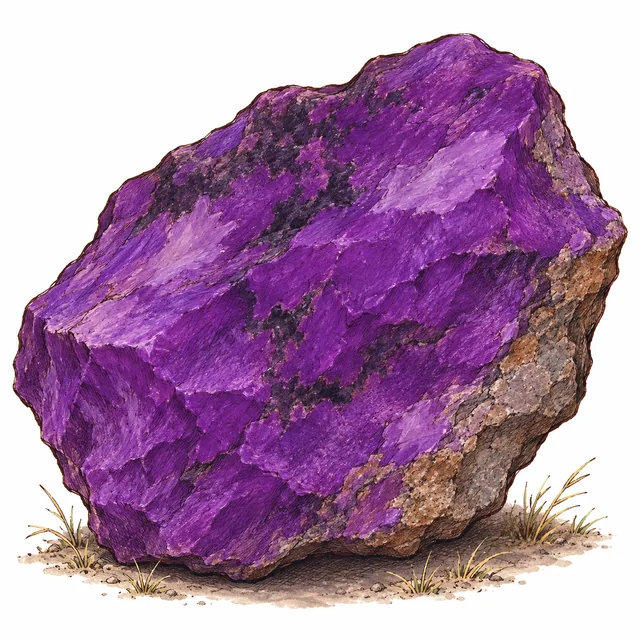
The amethyst offers another connection between power and value. Volmar mentions its violet colour. Whoever looks at it in the morning is supposedly protected from getting drunk that day. The poet adds that it would be worth a great deal if it were less common. The position is reversed with the carbuncle. Although it glows at night like an ember and has many powers, he passes over their details because hardly anyone could acquire such a stone.[1]
Near the end, Volmar returns to the question of what people can obtain. He mentions further stones said to protect against fire and drowning or even to restore the dead to life. He does not name them individually. God has put such exceptional stones beyond human reach, and life and death depend on his will. The religious order in which their powers are said to operate thus sets limits on possession and use.[1]
From natural images to magical engravings
The agate entry already describes figures inside a stone: human beings, wild animals and various images. Volmar stresses that they have grown there. They have never been cut, and scraping them away would destroy the stone. He expressly distinguishes natural markings from the engraver’s work.[1]
A later section is devoted to carved images. According to the poet, the ancients observed the stars and engraved gems at the appointed hours. Some pieces survived. He describes their figures precisely enough for a reader to recognise them on a gem in hand. Saturn appears as a king with a sickle. Perseus carries a sword and a severed head, and his image is said to protect against storms and lightning.[1]
With some images the setting and further components were also supposed to contribute to the effect. An armed man is associated with a steel ring. Another figure, described at length, could benefit more than the gem’s owner. An impression in red wax could be given to someone else to bring good fortune. On this account, an image could pass its power on through an impression.[1]
What copyists made of the poem
The Steinbuch circulated widely in manuscript and was also printed in Erfurt by 1498.[2][3] Its text was abridged and altered. Lambel found that several copies begin directly with the account of the stones and omit the poet’s personal dispute. Even his name varies: alongside Volemar and Wolckman, some copies give Joseph.[1]
A change in the amethyst entry shows how much might turn on a small shift. In one group of witnesses, protection from getting drunk became protection from drowning. Lambel discussed the difference in his comparison of the versions. The power passed on by the tradition could thus change.[1]
In St Gallen Codex 604 the Buchelin von den edelen staynen is bound together with saints’ lives and devotional texts. Its readers could encounter stone lore within a religious miscellany.[4] Volmar’s opening defence found a fitting setting there. For him, stones exerted their powers in a creation whose powers came from God.

 Phone: +43 677 628 66 628 |


 Search







 Cart