A free retelling from the Thousand and One Nights about a treasure beyond reach and an unlikely way to freedom.
Sindbad, a merchant from Baghdad, encounters wonders and dangers on his travels. One of his best-known adventures is his second voyage, which takes him to a valley full of diamonds. This retelling follows the English translation by the explorer Richard Francis Burton (1821–1890).[1][6]
Sindbad could have lived in comfort in Baghdad. His first voyage had made him wealthy. His house was peaceful, and he had good food and company in abundance. Yet one day he found himself longing for distant cities and islands again. He bought goods, had them tied up in bales and boarded a ship with other merchants.
At first all went well. They sailed from coast to coast, buying, selling and exchanging their wares. At last they reached an uninhabited island with trees laden with fruit, fragrant flowers and clear water. Sindbad went ashore, sat down beside a spring and ate some of the provisions he had brought. In the shade of the trees he fell asleep.
When he woke, the ship was gone.
He searched the shore, calling out and running this way and that. No one answered. The merchants and sailors had set off without noticing his absence. Now he stood alone on the island, cursing the moment he had left the safety of his house.[1]
At last he climbed a tall tree. Between sea, sky and treetops he caught sight of something white in the heart of the island. He climbed down and went towards it. Before him rose an enormous, smooth dome. He walked all the way round it looking for an opening. There was none.
Then the sky darkened.
Above him hovered a bird whose wings blotted out the sun. Sindbad remembered what travellers had told him about the roc, a giant bird said to carry even elephants to its young. Now he understood what lay before him. The white dome was an egg.
The roc settled on it and fell asleep. Sindbad unwound his turban, twisted the cloth into a rope and tied himself to the bird’s legs. Perhaps it would carry him somewhere people lived.
At dawn the roc rose into the air. It swept Sindbad up with it, higher and higher, until the island vanished beneath him. When at last the bird landed on a high hill, he hastily undid the knots and scrambled clear. The roc seized a huge snake and flew away.
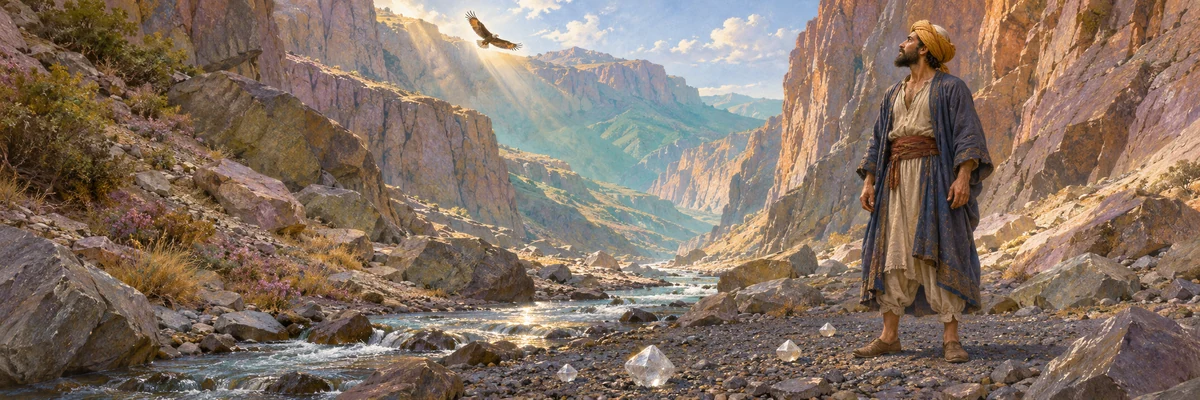
Sindbad walked on. A deep valley opened before him, ringed by mountains whose steep walls offered no way out.
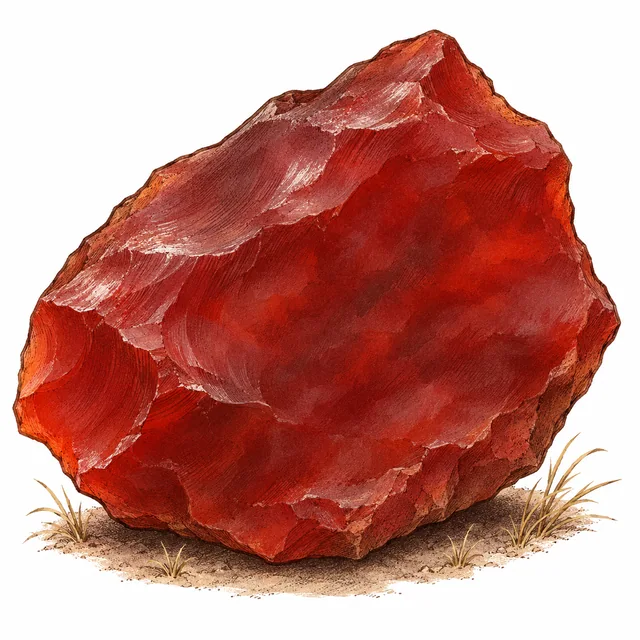
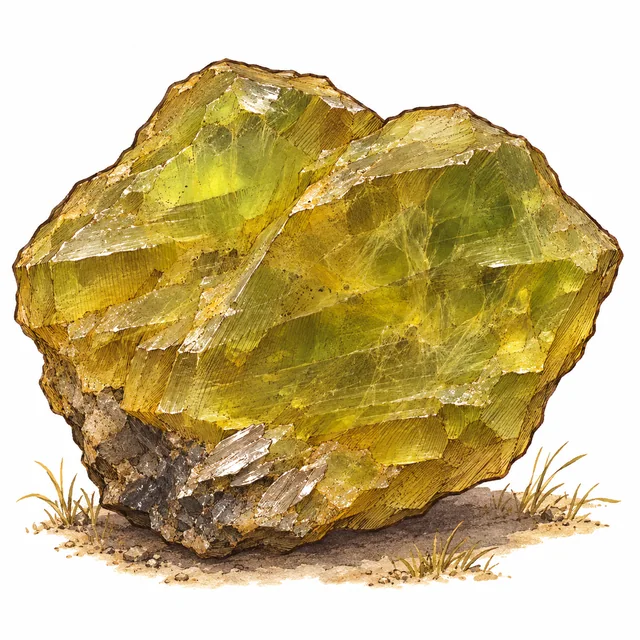
Diamonds lay on the ground.
The riches for which merchants crossed the seas lay at his feet. Yet among the stones lived snakes so large they could swallow an elephant. By day they hid from the birds. When darkness fell, they came out.
As evening drew near, Sindbad took shelter in a cave. He rolled a heavy stone across its narrow entrance and thought himself safe for the night. Then he peered farther into the cave.
There lay an enormous snake brooding over her eggs.
Sindbad stayed awake all night. Only at dawn did he push the stone aside and stumble out, exhausted from hunger, fear and lack of sleep.[2]
As he was making his way through the valley, the carcass of a freshly slaughtered animal fell to the ground in front of him. There was no one in sight. Then he remembered a story travellers had told him about the way merchants gathered diamonds in these inaccessible mountains.
They threw pieces of fresh meat down into the valley. The gems stuck to them. Eagles and vultures swooped down, seized the meat and carried it up to the mountaintops. The merchants waited there. They shouted to scare the birds away, then gathered up the stones.
Sindbad looked up at the cliffs.
Perhaps what could carry a diamond out of this valley could carry a man out too.
He gathered the finest stones and stowed them in his pockets and in the folds of his clothes. When another great piece of meat fell beside him, he unwound his turban. He lay on his back, fastened the meat over his chest and made himself as small as he could beneath it.
An eagle swooped down.
Its talons sank into the meat. A moment later Sindbad felt himself lift off the ground. The valley dropped away beneath him. The cliffs that only moments before had seemed like the walls of his grave slid past.
The eagle landed on a mountaintop and began to tear at its prey. Then came shouts and the clatter of wood. Startled, the bird spread its wings and flew away.[3]
Sindbad freed himself from the meat and stood up.
The merchant who had frightened off the eagle stopped short at the sight of him. He had expected gems and found a man. Then he examined the meat. Not a single diamond clung to it. His alarm gave way to loud laments over his lost profit.
“Fear not,” said Sindbad.
He explained that he too was a merchant and showed him the diamonds he had gathered in the valley. He gave him several of them. Soon the other traders joined them. They listened in wonder as Sindbad told them how he had been left behind on the island, how the roc had carried him into the mountains and how he had finally escaped the valley of snakes.
That night he slept among people again.
He continued his journey with the merchants. He exchanged some of his diamonds for goods, travelled through foreign lands and at last returned to Baghdad by way of Basra. There he gave presents to friends and relatives and shared his wealth with the poor. In the joy of coming home, the terrors of the voyage faded.[4]
The tale shows how even a valley full of diamonds can be worth less than the idea that saves a life at just the right moment.
About the tale
The story of the valley of diamonds predates Burton’s translation. It already appears in the 1806 French edition of Galland used for comparison here. Some scenes differ. In Galland the eagle carries Sindbad to its nest, and the merchant later settles for one smaller diamond. In Burton the eagle lands on a mountaintop, and Sindbad gives the trader several stones. The retelling above follows Burton’s version.[3][4][5]
The short quotation uses Burton’s English wording. The German version translates it from Burton.

 Phone: +43 677 628 66 628 |


 Search
 Etymologiae · 1911 · XVI, 14, 2
 Cart