A free retelling after Pliny about a herdsman, a stubborn stone and the wonder the ancients felt at forces they could not see.
The Roman writer and naturalist Pliny the Elder (c. AD 23–79) collected stories about the remarkable properties of stones in his Naturalis historia. One tells of a herdsman named Magnes, who made an unexpected discovery on his daily rounds.[1][5]
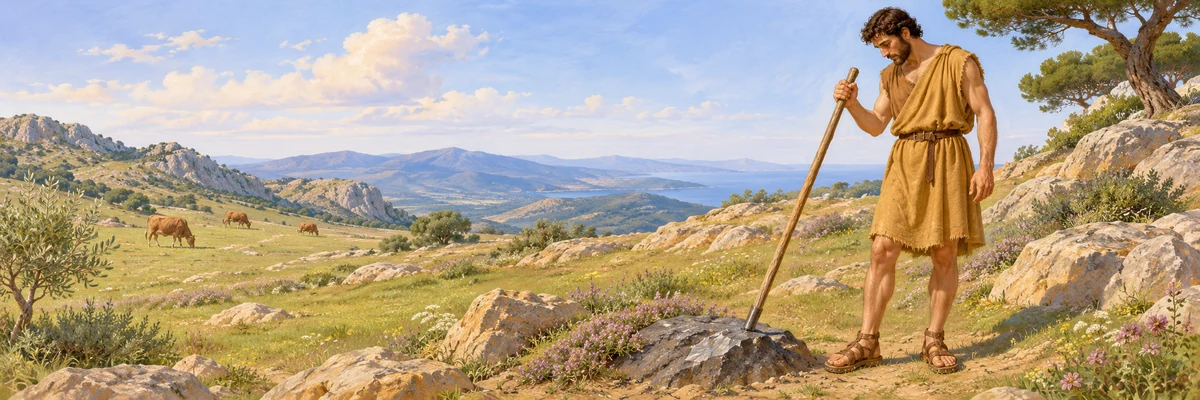
Magnes tended his herd on Mount Ida. The soles of his shoes were studded with nails, and the tip of his staff was shod with iron. So he made his way across the hillside with his animals.
Then something checked his stride.
As he went to lift his foot, he felt a pull. The nails in his shoe held fast to the rocky ground. Magnes set down his staff. Its iron tip stuck fast too.
It was as though the ground had reached out and caught him.
Magnes stood still. The things that a moment ago had carried and steadied him were now joined by something he could not see. It was the nails in his shoes and the iron tip of his staff. A stone was drawing the iron to itself.
While grazing his herd, Magnes had found a stone that could hold on.
That was the story people told of his discovery. And it was from the man who had found it, they said, that the stone took its name: magnes.[1]
A stone with hands
Something of the wonder in this little story can also be heard in Pliny’s own description. To him a stone seems stiff and inert. Yet in the lodestone it is as though nature has suddenly given it “feeling and hands”. Hard iron, with which so much can be subdued, leaps towards the stone and clings there as though in its embrace.[2]
“What could offer fiercer resistance than hard iron? Nature has given it feet and a character of its own.”
– Pliny the Elder, Naturalis historia, Book XXXVI, § 127. Our translation from the Latin.[2]
The Greek philosopher Plato (c. 427–347 BC) had already used the pull of the lodestone as an image. In his dialogue Ion he describes a chain of iron rings. The stone draws one ring to itself and gives it the power to hold another in turn. So the rings hang one from the next, and the power that holds the whole chain comes from a single stone.[3][5]
For Plato this is an image of poetic inspiration. The Muse takes hold of the poet. Through the poet the performer is moved, and the performer’s enthusiasm in turn reaches the listeners. Like the iron rings, they are linked, and the force passes from one to the next.[3]
The stone that brought a herdsman to a halt in the legend could thus also serve as an image of how one person can move another.
The story shows how a small obstacle underfoot can open our eyes to the forces of nature.
About the tradition
In his brief account Pliny mentions the herd, Mount Ida, the nails in the shoes and the tip of the staff that held fast. The sequence of events in this retelling is freely imagined. Its source is an ancient legend about a discovery and the origin of a name.[1]
Pliny names as his authority Nicander of Colophon, a Greek poet who probably lived in the second century BC. For Magnes himself the source gives neither dates nor any further details of his life.[1][4]
Isidore of Seville also tells the story. In his account Magnes is tending his herd in India. As in Pliny, the nails of his shoes and the point of his staff stick to the stone.[6] Giambattista della Porta places the herd back on Mount Ida. He mentions the hobnailed shoes and the shepherd’s crook as he weighs different explanations for the name of the stone.[7]
William Gilbert also knew the story. In his work on the magnet, published in 1600, he repeats both details and treats Pliny’s herdsman as a figure of fable.[8] A buckle does appear in Claudian’s poem Magnes. The poet lists ornaments for which the unassuming lodestone would be an unlikely choice. In this poem the buckle belongs to a warrior’s belt.[9]
In a modern retelling the stone also attracts a buckle. Writing in 2023, Jacek F. Gieras and Jian-Xin Shen recount that Magnes stood on a rock that attracted the nails and the buckle of his sandals.[10] In Pliny’s account the nails of his shoes and the tip of his staff cling to the stone. Isidore of Seville later gives the same two details.[1][6]
The short quotations from Pliny are our own translations from the Latin.

 Phone: +43 677 628 66 628 |


 Search
 The Composition of the World · 1858 · p. 109






 Cart