
 Phone: +43 677 628 66 628 |


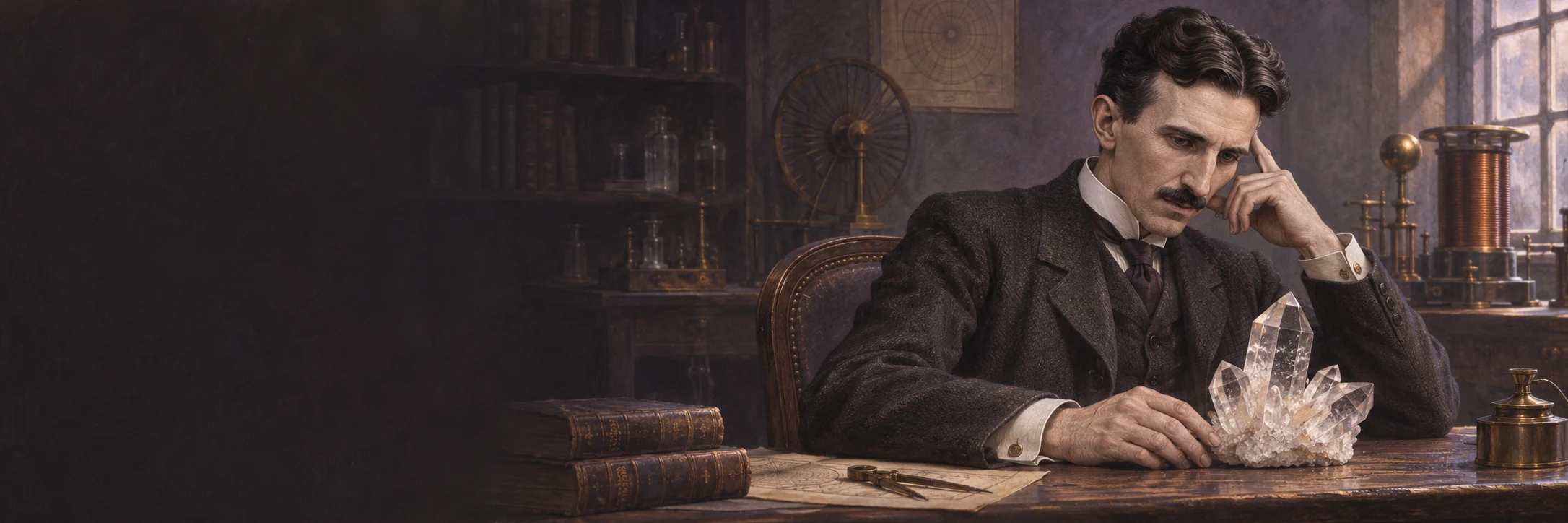
Nikola Tesla
In a crystal we have the clear evidence of the existence of a formative life-principle, and though we cannot understand the life of a crystal, it is none the less a living being.
Nikola Tesla (1856–1943)
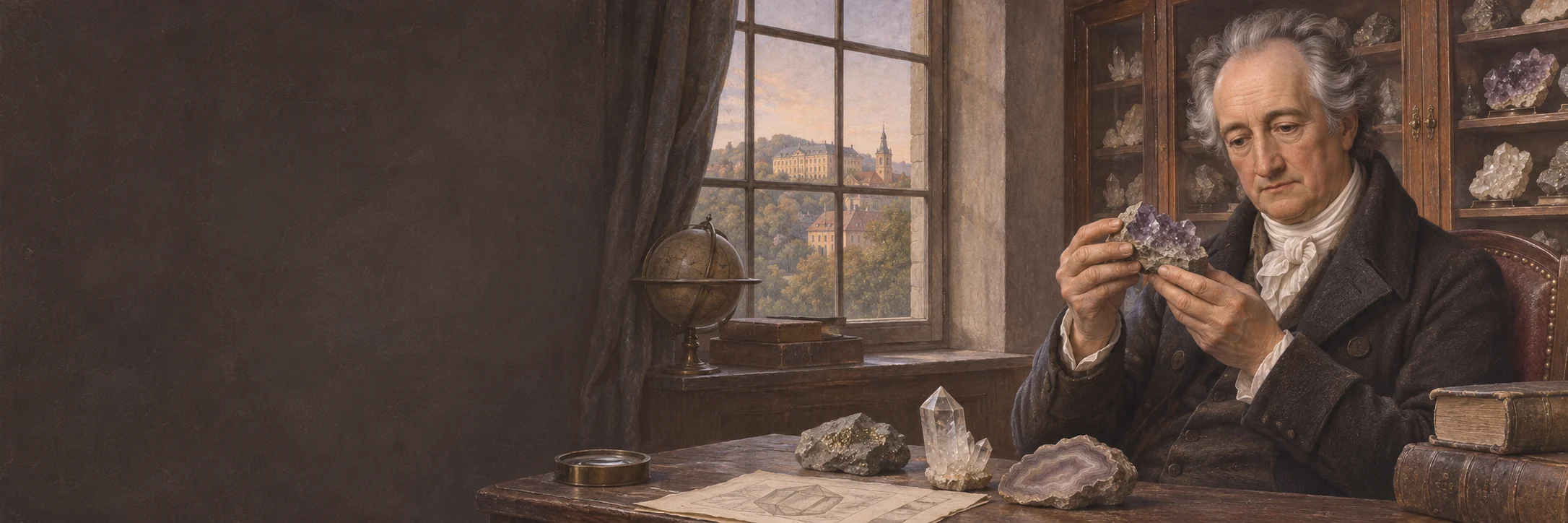
For Goethe, stones were objects of close scientific study. Beginning in 1777, he built up a geoscientific collection over some five decades. Today it comprises around 18,000 specimens. It supported his geological studies and accompanied his longstanding exploration of nature.
Minerals, rocks and fossils were arranged systematically. He also assembled collections relating to particular regions, including Thuringia, the Harz Mountains and Karlsbad. The arrangement he established has survived to this day. The collection is housed in the anteroom to his study at his home on the Frauenplan in Weimar and in the eastern garden pavilion.
Goethe’s engagement with nature was driven by a desire to understand its phenomena through careful observation. In his essay Der Versuch als Vermittler von Objekt und Subjekt (The Experiment as Mediator between Object and Subject), he describes a demanding approach: those who seek to study nature should consider things in their own relationships. Personal preferences, usefulness and expectations must not become the sole standard of judgement. Understanding requires a willingness to test one’s own ideas repeatedly against what is observed.
Stones make this approach particularly tangible. Their shapes, colours and structures reveal themselves through patient observation and comparison. Greater attention can give rise to new questions. Looking more deeply also makes us aware of how strongly our perception is shaped by our own ideas. In this way, engaging with nature can become an encounter with our own thinking.
“Stones are silent teachers; they make the observer silent, and the best that one learns from them cannot be communicated.”
Johann Wolfgang von Goethe (1749–1832), Wilhelm Meisters Wanderjahre, “Aus Makariens Archiv”. Our translation from German.[1]
Goethe’s words can be read as pointing towards an understanding that arises in the relationship between subject and object. The stone gives it a visible form; attentive contemplation makes it something that can be experienced. What unfolds in this encounter cannot be fully conveyed through language. Understanding arises through the encounter with the object and remains bound to personal experience.
This idea of understanding gained through personal experience can be related to Goethe’s Masonic background. He had been a member of the Amalia lodge in Weimar since 1780. In Masonic symbolism, the rough ashlar represents the individual and their development. Working on the stone symbolises working on one’s own character.
In this reading, Goethe’s contemplation of nature and his Masonic outlook merge in the stone. The principle discernible in it appears as an expression of an inner connectedness of life. Through attentive contemplation, a person can sense this connection and experience themselves as part of it.
Contemplation leads inward: those who turn their attention to the stone also encounter their own ideas, their limitations and their capacity for understanding. The mystery of the stone thus becomes something the observer discovers within themselves as well.
 Search
In a crystal we have the clear evidence of the existence of a formative life-principle, and though we cannot understand the life of a crystal, it is none the less a living being.
Nikola Tesla (1856–1943)
Stones are silent teachers; they make the observer silent, and the best that one learns from them cannot be communicated.
Johann Wolfgang von Goethe (1749–1832)
 Wilhelm Meisters Wanderjahre · 1829 · p. 267
Our translation from German
 Cart