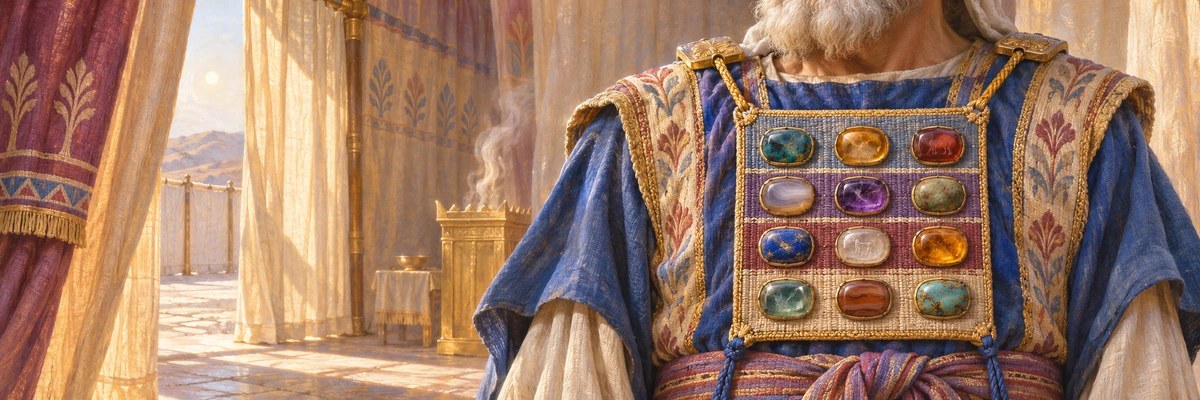
When Aaron entered the sanctuary, he was to carry the names of the twelve tribes of Israel over his heart. Each name was engraved on a gemstone. The twelve stones were set in four rows on a precious breastpiece. This is how the Book of Exodus describes it. The ornament was to keep the people of Israel present before God.[1]
The two biblical lists of stones later associated with the birthstone tradition appear in Exodus 28:15–30 and Revelation 21:12–21. The first passage describes the making and meaning of a priestly garment, the second the appearance of the heavenly Jerusalem. Both associate twelve stones with a religious community. Ancient interpretations of the priestly garment explicitly connect this number with the months and the signs of the zodiac.[1][2][3][4]
A city on twelve foundations
In Revelation, John sees the new Jerusalem coming down from heaven. The city has twelve gates bearing the names of the twelve tribes of Israel. Its wall rests on twelve foundations inscribed with the names of the twelve apostles. The account goes on to describe these foundations as adorned with precious stones. Through the number twelve, the vision connects the tribes of Israel and the apostles with the very structure of the city.[2]
The twelve stones are named in this order: jasper, sapphire, chalcedony, emerald, sardonyx, sard, chrysolite, beryl, topaz, chrysoprase, jacinth and amethyst. The gates, too, are precious. Each consists of a single pearl. The scale has changed considerably from that of the priest’s breastpiece. The gemstones now adorn an entire city and frame the names of the tribes and apostles.[2]
The priestly garment as an image of the year
Philo of Alexandria was already explaining a connection between the stones of the breastpiece and the heavens in the first century AD. In his Greek work On the Life of Moses, he examines how the stones are arranged. For him, the four rows of three stones correspond to the four seasons. Three signs of the zodiac belong to each season, and the solstices and equinoxes mark the divisions of the year.[3]
Philo also draws the different colours into his interpretation. Just as the stones differed from one another, so, he believed, did the effects of the zodiac signs on the world. He saw their influence in the air, the earth and the water, as well as in plants and animals. In this way, the arrangement of the breastpiece was to make visible an order that ran through the entire cosmos.[3]
Flavius Josephus makes the connection with the months particularly explicit. He completed his Jewish Antiquities around AD 93/94.
“One can understand the twelve stones as the months or as the same number of signs in the circle the Greeks call the zodiac. Either reading captures their meaning.”
– Flavius Josephus, Jewish Antiquities, III, § 186. Our translation from Greek.[8]
He interprets the two stones on the shoulders of the garment as the sun and the moon. This reading forms part of his wider account of the sanctuary and its furnishings as an image of the world.[4]
Here we find an early connection between stones and the course of the year. Josephus, however, does not assign anyone a stone according to their birth month. His explanation concerns the priestly garment and the meaning of its individual parts.[4]
How Jerome brought the two lists of stones together
Around AD 397, Jerome answered Fabiola’s questions about Aaron’s garments in a letter in Latin. He described the breastpiece with its four rows of stones and explicitly referred to the gemstones of the heavenly Jerusalem. The two biblical passages were thus already being read together in late antiquity. Jerome was interested both in the names of the stones and in their religious significance.[5]
In explaining the garment, he first recounted an interpretation that he said he had received from Jewish sources. In this reading, the twelve stones stand for the months or the zodiac, and their four rows for the seasons of three months each. The cosmic interpretation was thus also passed on in a Christian text.[5]
Jerome went on to propose other meanings. The four rows could stand for prudence, fortitude, justice and temperance, or point to the four Gospels. The same arrangement could thus be read in terms of the course of the year, the virtues or the proclamation of the Christian faith. The number of stones was the starting point for these different interpretations.[5]
From the course of the year to a stone for one’s birth month
In 1762 the Parisian jeweller Pouget fils gave a concrete account of the personal birthstone. In his French Traité des pierres précieuses, he described people who wished to wear the stone of their birth month on their finger. The sign for that month was also to be engraved on the stone. A single piece of jewellery thus brought together the material, the month of birth and the image of a zodiac sign.[6]
Pouget traced the series of birthstones back to the example of the twelve stones on the priestly garment. By his account, the series had originated in Germany some two hundred years earlier. That date is part of his account of the custom’s origins. He himself regarded the scheme as an invention to which its adherents attributed a mysterious significance.[6]
His table pairs each month with a zodiac sign and one or more named stones. It lists carnelian for July, aquamarine for October and topaz for November. The names and symbols of the zodiac signs appear alongside the stones. A reader could thus identify the sign that, according to the custom he described, was to be engraved on the stone of the ring.[6]
An American list that remains influential today was established in 1912 by the American National Retail Jewelers Association, the predecessor of Jewelers of America. Today the association lists several stones for some months. For June it gives pearl, moonstone and alexandrite.[7]
Someone born in April could find sapphire listed as their stone in Pouget’s table. In the American list used today, the same person would find diamond. The month of birth stayed the same, while the stone associated with it changed with the list consulted.[6][7]

 Phone: +43 677 628 66 628 |


 Search

 The Theatre of Terrestrial Astronomy · XII · 1893 · p. 142











 Cart