Nikola Tesla (1856–1943) was a Serbian-American inventor and electrical engineer. In The Problem of Increasing Human Energy, he connects questions of energy production with reflections on nourishment, human progress and possible forms of life. The crystal leads him beyond the boundaries of familiar living organisms.[1]
The crystal as a living being
Nourishment is his starting point. Tesla considers food a foundation of human capability and advocates a plant-based diet. He then asks a broader question: must every conceivable living being take in food, or could it obtain its energy directly from its surroundings? The complete passage in which he introduces the crystal reads:
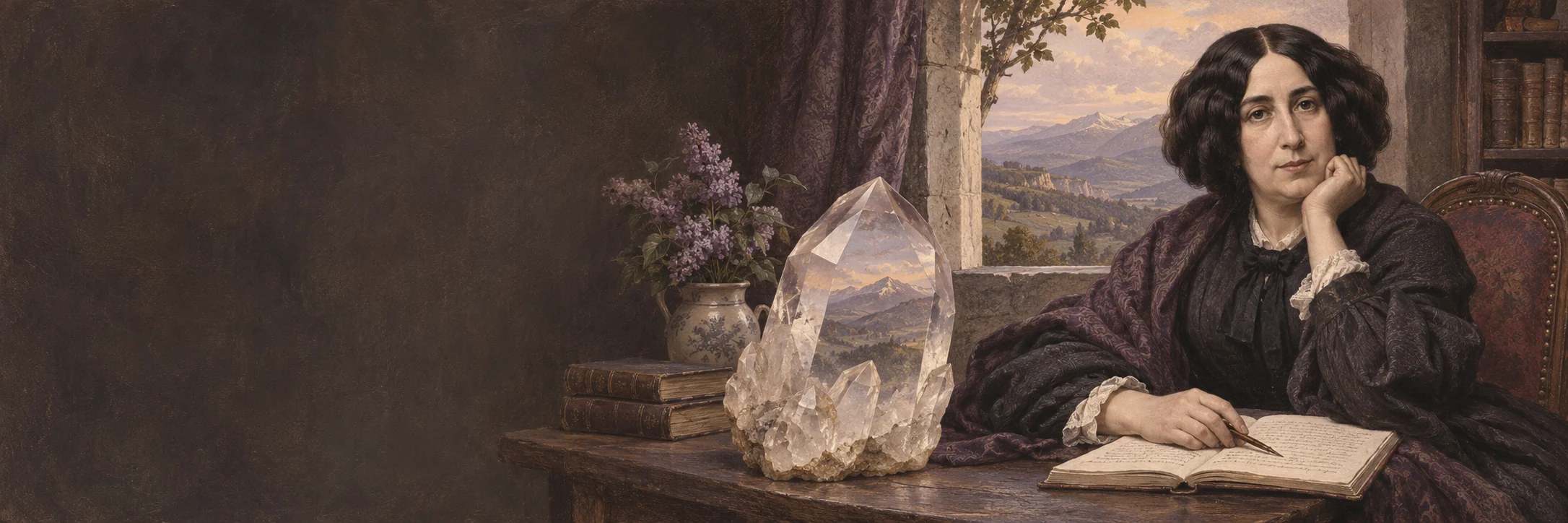
“There seems to be no philosophical necessity for food. We can conceive of organized beings living without nourishment, and deriving all the energy they need for the performance of their life-functions from the ambient medium. In a crystal we have the clear evidence of the existence of a formative life-principle, and though we cannot understand the life of a crystal, it is none the less a living being. There may be, besides crystals, other such individualized, material systems of beings, perhaps of gaseous constitution, or composed of substance still more tenuous. In view of this possibility,—nay, probability,—we cannot apodictically deny the existence of organized beings on a planet merely because the conditions on the same are unsuitable for the existence of life as we conceive it. We cannot even, with positive assurance, assert that some of them might not be present here, in this our world, in the very midst of us, for their constitution and life-manifestation may be such that we are unable to perceive them.”
Nikola Tesla, The Problem of Increasing Human Energy, 1900, p. 180. English original.[1]
The expression formative life-principle denotes a principle that gives rise to form. To Tesla, the ordered shape of a crystal suggests an activity that cannot be confined to familiar ideas about nourishment and organic life. He explicitly attributes a life of its own to the crystal, while acknowledging that its processes remain beyond his understanding.
Other possible forms of life
This thought opens the way to beings made of gases or still finer substances. Their manifestations of life might differ so greatly from ours that we would fail to recognise them. For the same reason, Tesla does not judge other planets solely by the conditions required by terrestrial organisms.[1]
The crystal becomes an invitation to reflect on the limits of perception. In Tesla’s reasoning, what appears motionless to us need not lack an inner activity. This is a philosophical exploration of possible forms of life, rather than an experimental demonstration that crystals are living organisms in the modern biological sense.

 Phone: +43 677 628 66 628 |


 Search
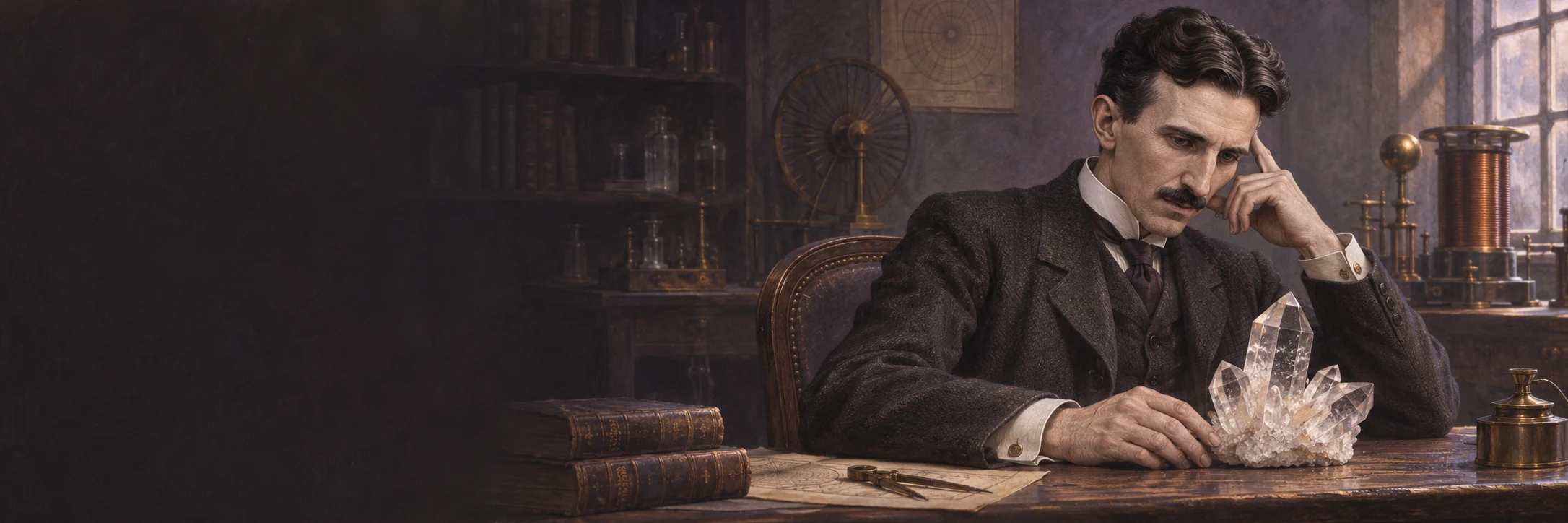
 The Problem of Increasing Human Energy · 1900 · p. 180
 Cart