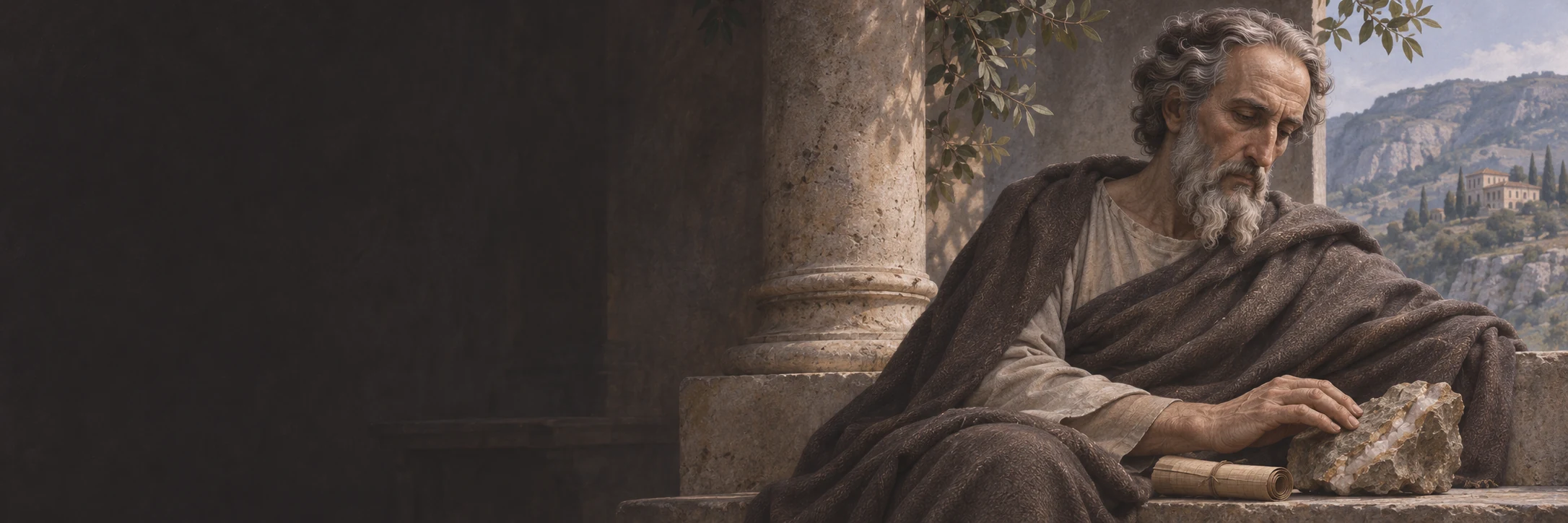
Plotinus (c. 204/205–270) was a Greek-speaking philosopher of late antiquity, born in Egypt, who taught in Rome. In his Enneads, he considers the earth as a living whole. For him, the formation and shape of stones belong to a nature that brings forth its forms from within.[1]
Form arising from within
A stone first presents itself as something solid and seemingly complete. Plotinus turns his attention to the process of becoming that precedes this shape. The growth of stones and the formation of mountains point, in his account, to a creative activity within the earth. Hermann Friedrich Müller’s German translation expresses the thought in the following passage, translated here into English:
“As regards the growth and formation of stones and the internal transformations of mountains as they rise, we must surely assume that an ensouled formative principle brings them into being within and shapes them according to their kind, and that this is the creative form of the earth, like what is called nature in trees; that what is called earth is analogous to the wood of a tree, and that a stone which has been cut off is like something broken from the tree, whereas, if this has not happened and it remains connected with the whole, it is to be regarded as an unsevered branch on the living tree.”
Plotinus, Enneads VI, 7, 11; excerpt, our English translation from Müller’s German edition of 1880.[1]
The “ensouled formative principle” is a shaping reason, a Logos, at work in nature. The shape of the stone expresses an inner order. What we see on its surface belongs to a relationship between formation, matter and form. Plotinus speaks here of the earth’s creative nature: his argument concerns the principle through which it takes shape.[1]
The stone and the living whole
To make this idea tangible, Plotinus compares the earth to a tree. As long as a stone remains connected to it, it resembles a branch on a living tree. A stone broken away from the earth is like a piece of wood cut from the tree. The individual piece can be examined and held in the hand; its origin lies in the greater whole from which it emerged.[1]
From this living earth, Plotinus develops his thought towards the intelligible order from which visible nature receives its form. Within this view, the stone belongs to a world in which life and formation are connected. Its silent, solid appearance preserves something of a becoming that extends beyond the individual object.
To look at a stone in this way is to encounter its origins through its shape. Attention moves from the individual surface towards the relationships that brought it into being. An apparently motionless object thus opens a view onto nature’s creative activity, made visible in a particular thing.

 Phone: +43 677 628 66 628 |


 Search
 The Problem of Increasing Human Energy · 1900 · p. 180




 Cart