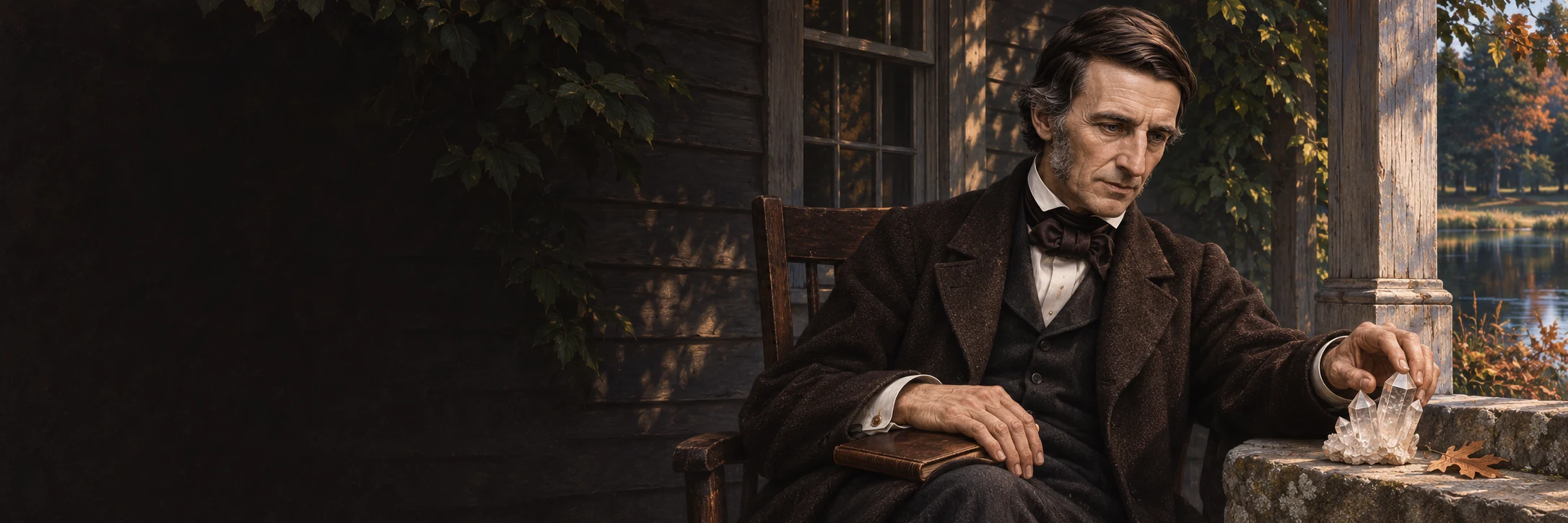
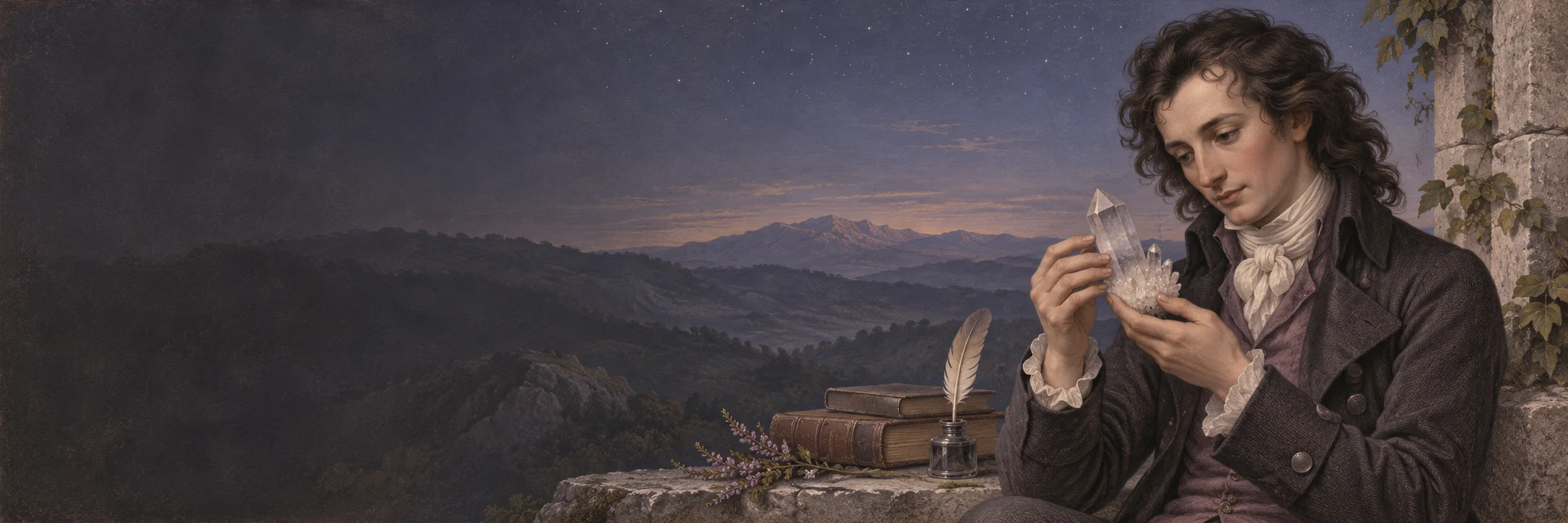
Ralph Waldo Emerson (1803–1882) was an American essayist, poet and philosopher. In Nature, he considers the natural world as an interconnected whole that becomes visible in individual things. A leaf, a drop and a crystal can each open a view of the same encompassing order. Attending closely to such an object means encountering a part of the world that also points beyond itself.[1]
The whole in an individual crystal
A crystal has a particular shape. Its faces, edges and proportions reveal an order that becomes accessible through observation. For Emerson, the significance of such a thing extends beyond its bounded form: the particular is related to the whole. He develops the thought in this complete paragraph:
“Herein is especially apprehended the Unity of Nature, — the Unity in Variety, — which meets us everywhere. All the endless variety of things make a unique, an identical impression. Xenophanes complained in his old age, that, look where he would, all things hastened back to Unity. He was weary of seeing the same entity in the tedious variety of forms. The fable of Proteus has a cordial truth. Every particular in nature, a leaf, a drop, a crystal, a moment of time is related to the whole, and partakes of the perfection of the whole. Each particle is a microcosm, and faithfully renders the likeness of the world.”
Ralph Waldo Emerson, Nature, chapter V, “Discipline”, pp. 54–55; complete paragraph from the first edition of 1836, with line breaks and end-of-line word divisions removed.[1]
The idea of the microcosm gives this thought its particular depth. The small becomes an image of a larger connection. Leaf, drop and crystal differ in their constitution, yet for Emerson they participate in a common reality. Their individuality remains visible while something universal appears within it. Unity lies, for him, in the very diversity of appearances.
Emerson goes on to seek affinities even between things that look very different. He names granite and the river that wears it away, as well as air, light and heat. His reflection reaches towards a common spiritual source of nature. Resemblances become traces of a unity that also permeates thought. This is the philosophical reach of his image of crystal: the object belongs to a world whose connections may become accessible through attentive understanding.[1]
What contemplation develops in us
For Emerson, our relationship with nature also changes the person who observes it. At the beginning of the chapter, he describes the properties of matter as a school for the understanding. Resistance, extension, shape and divisibility invite us to distinguish, compare and recognise connections. The world continually offers thought material and room for its activity.
Such attention joins precision with openness. Emerson emphasises that things have their own particular properties and should not be lumped together indiscriminately. Perceiving their differences makes a deeper understanding of their relationships possible. A crystal offers a way to follow this approach: we attend to its specific form and can also ask what order becomes visible within it.[1]
Emerson’s sentence can thus be read as an invitation to linger over small things. A single stone may become the starting point of a reflection that reaches beyond its immediate appearance. Moving between close observation and wider thought gives the object a new depth. The world appears as an interconnected whole in which both the thing observed and the person observing participate.

 Phone: +43 677 628 66 628 |


 Search
 The Problem of Increasing Human Energy · 1900 · p. 180
 Cart